
An inline shower filter is worth considering when you want to keep your existing shower head; a filtered handheld shower head combines the handset and its filter system in one replacement. Choose between them by checking the permitted installation position, connections, handling and refill access, rather than assuming one layout filters better. Keeping the old shower head does not guarantee that the complete setup will feel or operate exactly as before.
- Decide which existing parts you want to keep before selecting a filter.
- Check connection details and working space, not just the label "universal."
- Compare flow, spray feel and filtration evidence separately.
- Confirm how to replace the cartridge before approving the kit.
1. What do you keep, and what do you replace?
What is an inline shower filter?
An inline shower water filter is a separate filter housing installed along the shower water path. You may be able to retain the existing head, but the filter's instructions must permit the proposed connection and position. The housing, fittings and cartridge become additional parts of the system you need to accommodate.
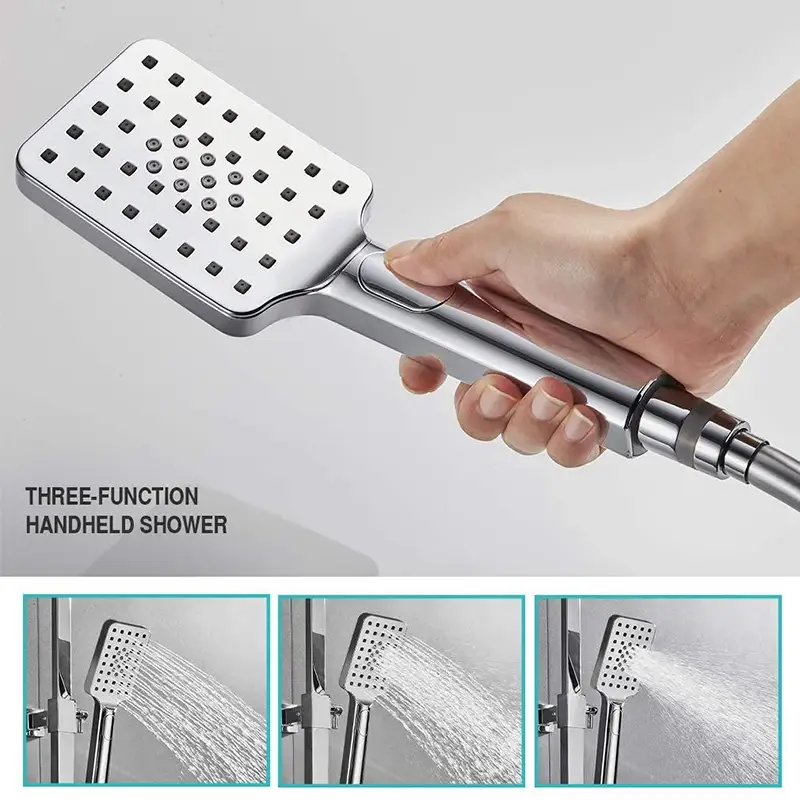
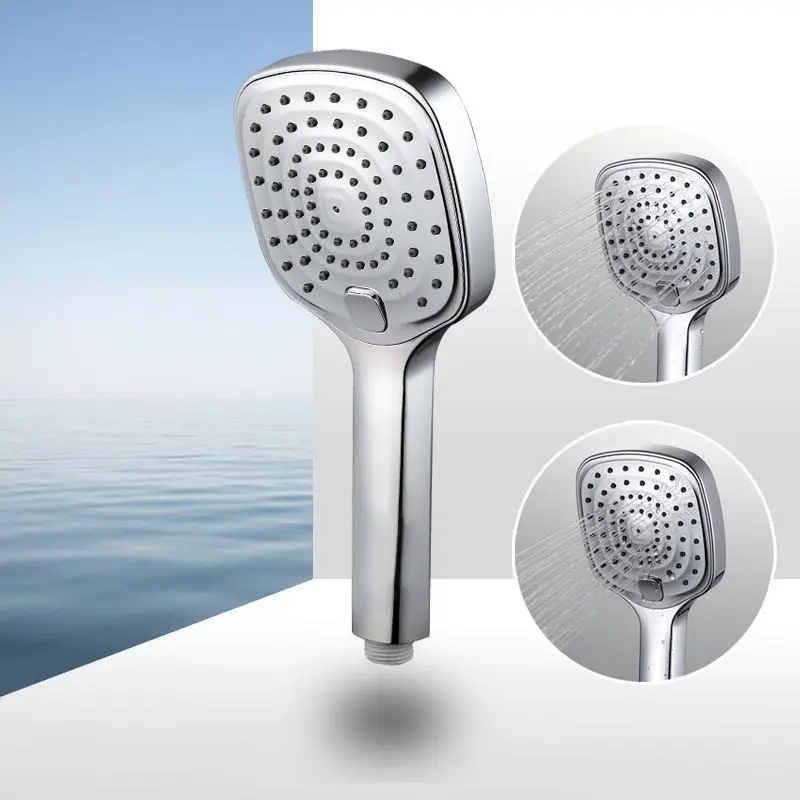
A filtered handheld shower head instead incorporates its filter system into the handset. Selecting that format replaces the handset. It does not automatically require a new hose, holder or mixer, although each retained component still needs a compatibility check.
| Decision | Separate inline filter | Filtered handheld head |
|---|---|---|
| Existing handset | Can remain if the complete combination is suitable | Replaced by the filtered handset |
| Filter location | Separate housing in a permitted position along the water path | Inside the handset's filter system |
| Fit to confirm | Housing, connections, supports and servicing space | Connection, grip, holder contact and servicing access |
| Next cartridge change | Follow the housing's specific opening or removal procedure | Follow the handset's cartridge replacement procedure |
Handheld versus fixed is a different comparison
A handheld shower describes how you hold and position the head. Inline describes where a separate filter sits. Those categories can overlap: an inline filter may serve a handheld head when the products support that arrangement. Conversely, a built-in filter does not identify the spray modes, connection details or treatment performance.
At Huanyu, the FHS50001 filtered handset provides a concrete built-in example. For a broader explanation of filter types and media, use our filtered shower head guide. Here, the buying decision is narrower: which configuration fits the shower you actually have?
2. Where can an inline filter sit in a handheld shower setup?
Two separate housings sold as inline filters may require different positions. Check the model's instructions before deciding that a filter belongs at the wall outlet or beneath the handset. Position changes which parts carry it, which components move with it and where you need access for servicing.
At the outlet, before the hose
When both the filter and shower equipment permit this location, the filter can sit upstream of the hose. Check nearby controls, the bath edge and the hose's natural route. Leave room to assemble and service the housing. A body that fits between surrounding objects may still lack the clearance needed to turn or open it.
Between the hose and the handset
This position moves the added component with the hand shower. If permitted, evaluate it as part of the grip and holder assembly. Look at where the holder supports the combination and whether the hose pulls it out of the preferred angle. Do not assume wall-end and head-end installations have the same handling effects.
With an overhead and a handheld outlet
Trace the split between the two outlets. A filter placed only in the handheld branch does not also treat water taking the separate overhead branch. Confirm the permitted arrangement rather than relocating parts around a diverter by guesswork. Where simultaneous use is supported, check the operating conditions for that complete arrangement as well.
3. Will an inline shower filter fit your existing shower?
Check four things before buying: the connection and seal, the space for assembly and servicing, the hose and holder, and the equipment's permitted configuration. A nominal connection size answers only part of the first question.
Identify the thread and the sealing method
Ask for the thread designation, connection direction and intended sealing components. FHS50001 lists a G1/2 BSP connection. Do not reduce that information to "half-inch" and assume any other half-inch fitting is equivalent.
The public abstract of ISO 228-1 describes parallel fastening threads whose pressure-tight seal is made outside the threads with an appropriate seal. Separately, ASME B1.20.1 covers dimensions and gauging for thread families including NPT. These are reasons to identify the actual connection system, not instructions to compensate for a mismatched fitting with extra tape.
Measure three kinds of space
Record three separate spaces: where the housing stays, the movement needed to assemble it, and the access needed to remove the cartridge. A housing can fit its final position yet be trapped there because an adjacent control prevents it turning or a shelf blocks refill removal. I would reject that layout before sample approval, even if its thread fits. Request the opening direction and the part that must move, not only the housing's overall dimensions.
Include the hose, holder and equipment instructions
Confirm where the holder contacts the assembly and whether the retained hose can follow its route without being forced against surrounding fittings. Also check the shower equipment's instructions. Electric showers, instantaneous heating equipment and other specific systems require their own compatibility assessment; a filter connection alone is not permission to add restrictions or adapters.
If the documentation does not establish a permitted combination, resolve that question with the equipment supplier or a qualified installer before assembling it. Avoid buying several adapters first and trying to make the space work afterward.
4. Keeping the shower head does not mean keeping the same handling
You can retain the original spray face and still change how the shower feels in your hand. A component added beneath the handset becomes part of the moving assembly. An outlet-side housing occupies a different position, so compare the actual arrangements rather than ranking all inline filters as heavy or all integrated heads as light.
Check the movements you use every day
With a permitted sample configuration, take the handset down, hold it where you normally grip it, change its direction and return it to the holder. Check whether the holder supports the intended area rather than catching a connection or housing edge. Then examine the parked spray angle and whether the hose pulls the assembly away from it.
For someone using a shower while seated, easy access to the grip may matter more than a neat photograph of the assembled fittings. For someone rinsing a bath, the hose route and useful reach may be the deciding factors. These are different tasks; one product dimension cannot settle both.
Compare complete assemblies on the same basis
If weight matters, define what is on the scale: handset alone, handset with cartridge, or the connected moving assembly. Keep that basis consistent across candidates. A catalogue weight without its component list cannot show how two installed combinations compare.
I would not put an added housing below a handset merely to preserve the old spray face if the resulting grip becomes awkward. First evaluate a permitted outlet-side position. If that position cannot be assembled and serviced in the available space, a replacement filtered handset becomes the more useful candidate. That recommendation depends on where the assembly is supported and how it moves, not a blanket claim that built-in filters are lighter or better.
5. Compare flow, spray feel and filtration as separate results
Moving a filter does not, by itself, prove better filtration or unchanged spray performance. Separate the questions: how much water exits, how the spray feels and distributes, and what treatment performance the specific model supports.
Record conditions before judging the spray
If you compare an existing handset before and after adding a permitted inline filter, retain the same hose, spray setting and measurement method where possible. Record the operating conditions and cartridge state. If you replace the whole handset, acknowledge that the spray face and internal water path have changed too. The difference cannot be assigned solely to filter location.
| Question | Useful record | What it does not establish |
|---|---|---|
| How much water exits? | Collected volume, collection time, setting and operating conditions | Pressure at the supply or a chemical removal rate |
| Is the spray usable? | Coverage and spray feel at the intended position | Filter capacity or contaminant reduction |
| Does the filter meet the treatment goal? | Model-specific claim, conditions, capacity and applicable certification evidence | Results for another model, cartridge or installation |
The EPA WaterSense showerhead guidance evaluates spray force, spray coverage and pressure compensation separately. That distinction is useful when comparing layouts. Huanyu lists FHS50001 at 2.5 GPM at 80 PSI, with a 1.8 GPM option; this is a model specification with a stated condition, not proof of constant flow at every pressure or a WaterSense certification claim.
Do filtered shower heads work differently when the filter moves?
Do filtered shower heads make a difference? Answer that for the treatment target and model, not the housing's position. The NSF explanation of treatment standards identifies NSF/ANSI 177 with free available chlorine reduction. It also warns that certification does not establish reduction of every contaminant.
Is an inline shower filter a water softener?
An inline housing is not evidence of softening. NSF describes hardness reduction by ion exchange separately under NSF/ANSI 44. If your goal is reducing dissolved hardness, ask for evidence of that capability rather than relying on the words "shower filter for hard water." Keep that question separate from visible sediment, spray appearance or cartridge colour.
6. Plan the next cartridge change before choosing the layout
A filter that fits today still needs to be serviceable later. Before comparing replacement intervals, find out what has to come apart. A separate housing may need removal from its connection; another design may open in place. A built-in filter may allow cartridge replacement without replacing the whole handset. Use the actual instructions for each candidate.
Match the cartridge to the housing
Record the cartridge identifier, housing version and any replacement seals. Similar length, colour or media descriptions do not establish interchangeability. If a supplier updates a housing, ask how the refill packaging distinguishes the versions. This matters for a homeowner ordering one refill and for a distributor supporting stock sold over several seasons.
Check the initial kit separately. Does it contain the first cartridge, additional refills, a hose, a holder or only the main unit? An attractive kit photograph is not a packing list. Include any necessary accessories in the comparison before deciding that one layout costs less.
Separate filtration, fragrance and cleaning tasks
FHS50001's published replacement guidance distinguishes its PP cartridge from its aroma consumable. Do not combine them into a single maintenance deadline. Likewise, cleaning the spray face and replacing treatment media answer different maintenance needs. A viewing window helps you observe the cartridge; appearance alone does not establish remaining chemical treatment capacity.
For the broader timing question, see our shower filter replacement guide. In this comparison, ask a more practical question: can the person responsible for maintenance obtain the correct refill and complete the required action in the available space? A lower initial price loses its appeal if servicing requires a configuration the bathroom cannot accommodate.
7. Which setup fits your household, hotel or retail range?
Start by identifying what you would dislike losing. If your current handset has the spray pattern and grip you want, evaluate a compatible inline filter first. If you are willing to replace the handset, a built-in option lets you assess the grip, spray and filter arrangement together. Neither route removes the need for the preceding fit checks.
A built-in product example: Huanyu FHS50001
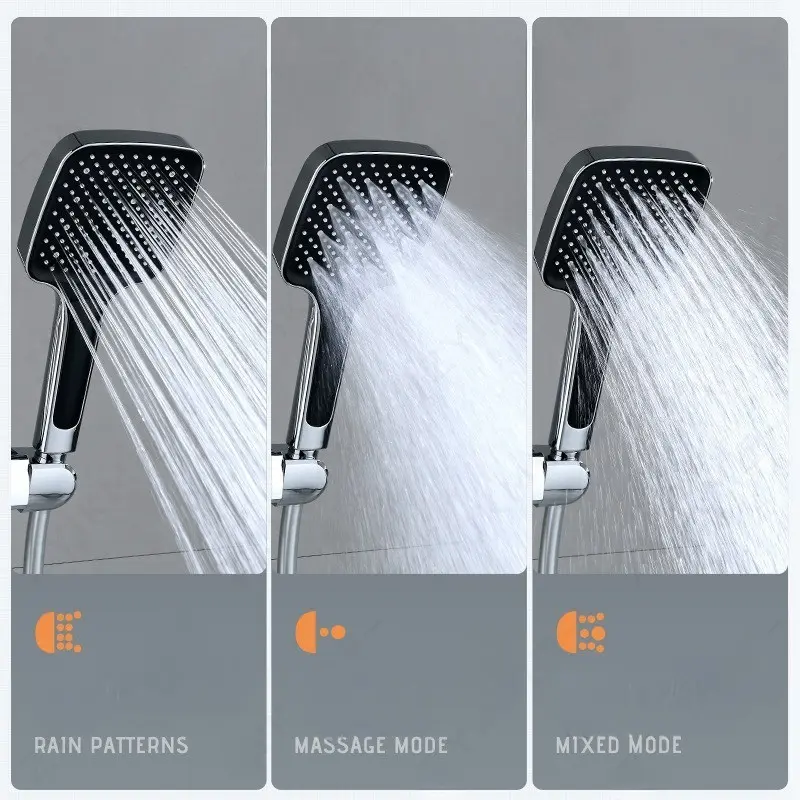
We use FHS50001 to show the trade-off concretely. Its product specification lists an 87 mm size, ABS body and G1/2 BSP connection, with a replaceable PP filter in the handle and a viewing window. The standard spray configuration is a single rain setting; optional spray adjustment should be specified separately. See the FHS50001 product details when defining the version to sample.

The published PP cartridge interval is 3 to 6 months, depending on water quality and use. The aroma cartridge has a separate 2 to 3 month reference interval, and filtration can operate without the aroma cartridge. The practical result of this arrangement is separate servicing of the consumables within a replacement handset, not proof of better treatment than an external filter.
Choose for the person who will maintain it
For a household, prioritise the daily grip and the next refill. For a hotel, agree on a repeatable servicing procedure and matching replacement parts before rolling out a configuration. For a retailer, confirm the exact kit contents, refill identifiers and support photographs. Our SPA hand shower range provides other product options, but the approval should still identify one specific version rather than borrowing specifications from neighbouring models.
8. Our factory view: approve the complete kit, not only the handset
From the factory side, we recommend checking whether the assembled shower remains useful, rather than stopping when the connections screw together. An external filter beneath the handset can change grip length and holder contact; an outlet-side filter needs its own assembly and refill space. If clearance is inadequate, adding adapters is not a substitute for reconsidering the permitted position.
Our preferred approval record would identify the retained parts, proposed water path and service access together. That makes a sample decision usable after delivery, when another person needs to replace a seal or order a cartridge.
How to build a shower filter configuration approval record
Use this sequence to compare a built-in handset with a permitted inline-filter setup. It is a purchasing and sample-check method, not a substitute for the equipment's installation instructions.
-
Identify the parts to retain
List the existing outlet, hose, holder and handset. Photograph their connections and the surrounding space. State whether preserving the current handset is essential or simply preferred.
-
Confirm the permitted water path
Check the filter and shower equipment instructions for the proposed position. Mark the diverter and each outlet on a simple layout. Resolve uncertain permissions before buying or fitting additional components.
-
Document the connections and clearances
Record thread designations, connection directions and sealing parts. Check installed space, assembly movement and refill access separately. Obtain a drawing where the connection details are unclear.
-
Check the complete sample in use
For an approved combination, follow the supplied installation and checking instructions. Assess retrieval, grip, holder contact, hose routing and spray. Record operating conditions alongside any flow measurements.
-
Match refills and packing contents
Identify the cartridge and housing version, replacement seals and supplied accessories. Check the servicing action and where the correct refills will be obtained. Keep fragrance consumables separate if present.
-
Save the configuration for handover
Keep the selected model and version, component list, instructions, photographs and applicable inspection records together. Identify who needs the record for installation, maintenance or after-sales support.
Huanyu's service process includes technical drawings, product photographs and videos, assembly checks for leakage and function, and pre-shipment inspection records. Our equipment information describes dimensional, sealing, pressure and flow checking capabilities. Request records relevant to the selected configuration. An assembly check answers an assembly question; chemical treatment claims need their own evidence.
9. Frequently asked questions
Can I use an inline filter with my existing handheld shower head?
Yes, if the filter and shower equipment permit the combination and installation position. Confirm the connections, seals, clearance, hose route and holder contact. Keeping the original head is a reason to consider an inline filter, but it does not prove that the complete assembly will fit or handle well.
Does a filter on the handheld hose also filter the overhead shower?
Not when the overhead water takes a separate branch that bypasses that filter. Trace the path through the diverter and both outlets. Do not assume that adding a filter to one hose treats every shower outlet, or move it elsewhere without confirming the permitted installation.
Does a 1/2-inch connection mean the whole setup will fit?
No. Confirm the actual thread designation, connection direction and sealing method, then check space and component support. A matching connection does not establish holder fit, comfortable handling, refill access or permission to use the filter with the shower equipment.
Do I replace the entire filtered handset when its cartridge is due?
Not necessarily. FHS50001 has a replaceable PP filter, so its maintenance plan distinguishes the cartridge from the handset. Other models require their own instructions and matching parts. Check the replacement procedure and refill availability before choosing either a built-in or separate housing.
Can I stack an inline filter and a filtered shower head?
Do not assume that two filters provide a better result. Check permission for the complete combination, its operating requirements and the treatment goal. Stacking also adds components and maintenance tasks. Choose a configuration with relevant evidence rather than treating filter count as a performance rating.
Are replacement cartridges interchangeable between brands or housing versions?
Do not assume interchangeability from similar appearance or a shared media description. Match the cartridge identifier and housing version, including the specified seals and installation direction. Keep that information with the kit record so the next refill order is based on the actual product rather than a photograph alone.