
By Ningbo Huanyu Sanitary Ware, hand shower manufacturer & exporter, Cixi · Updated August 2026
Search this question and you get answers ranging from every four weeks to every six months. That is a sixfold spread for what looks like the same product. No wonder buyers assume someone is exaggerating.
Nobody is necessarily lying. The intervals differ because the cartridges differ, and almost no listing explains that. Here is what actually drives the number, and how to judge your own filter instead of trusting a figure printed on a box.
The single biggest variable is how much media the cartridge holds, and this is rarely stated.
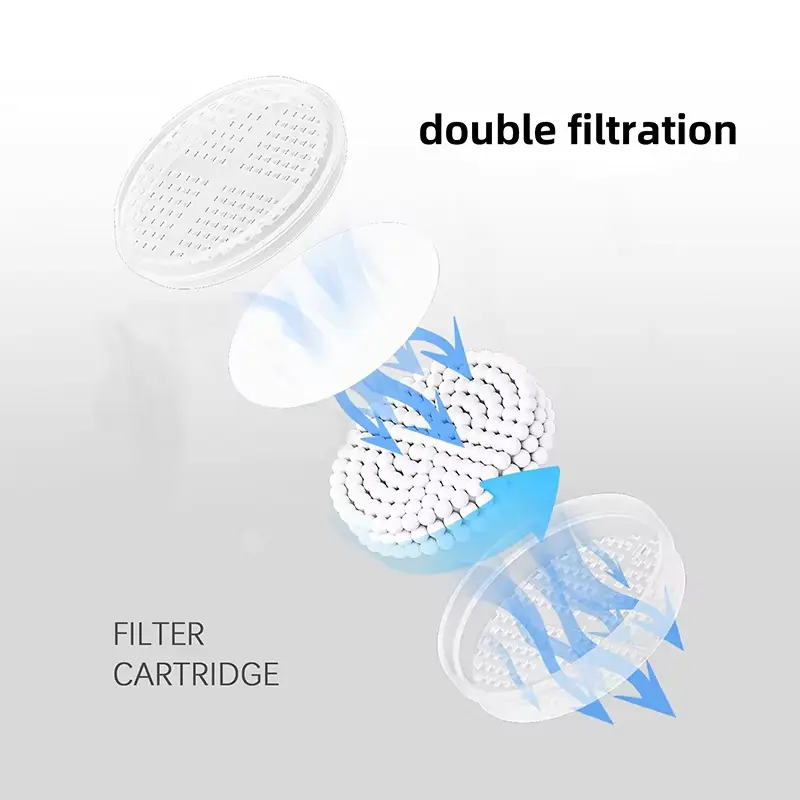
Many replacement cartridges sold online are small cotton plugs, a few centimetres long, designed to drop into slim universal handles. They hold very little polypropylene fibre. They load up with sediment fast, and a four-to-six week interval is honest advice for them.
A full-size cartridge built into a purpose-designed handle holds several times more media. Ours are rated to about 5 microns and last 3 to 6 months in normal use, as on the High Pressure Filter Detachable Shower Head. Same material, same job, very different capacity.
So an interval on its own tells you nothing. It only means something next to the cartridge size and your water. When you compare products, compare the cartridge, not the claim.
Three things use up a filter, and they act differently.
Sediment load. This is physical. Rust, sand and scale flakes fill the fibre until water struggles through. Older plumbing and hard-water supply accelerate this sharply. The US Geological Survey classifies water hardness on a measurable scale, and in the hardest supply areas the sediment burden can halve a cartridge's working life.
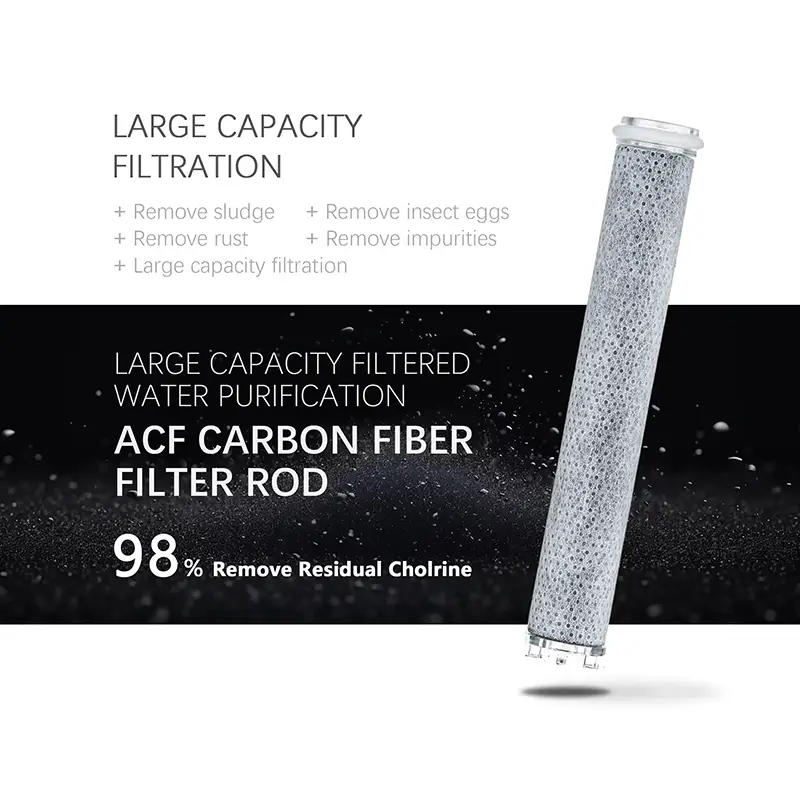
Chlorine capacity. This is chemical, and it behaves nothing like sediment. Carbon or KDF media adsorb chlorine until they are saturated. There is no visible sign. A cartridge can still look usable while its chlorine stage is finished.
Volume of water. A family of five exhausts a cartridge far faster than a couple. Hotels and gyms faster still. Usage matters more than elapsed time, which is exactly why calendar advice misleads.
Forget the date on the box. Watch the product.
Colour. New cotton is white. As it works, it turns yellow, then brown. A transparent window on the handle makes this a two-second check. This is the most reliable signal, and it is the reason we build the window into models like the Health Filter Handheld Shower with PP Cotton Filter.
Flow. A gradual weakening of the spray usually means the fibre is packed. This often arrives before the colour looks dramatic, particularly in sediment-heavy water.
Smell. If the chlorine odour returns at the start of a hot shower, the chlorine-reducing stage is spent, even if the cotton still looks acceptable. This is the signal people miss, because they are watching the colour.
Any one of the three is enough. You do not need all three.
This is the most common misdiagnosis we see, and it wastes cartridges.
Limescale builds up inside the spray nozzles as well as inside the filter. Both cause weak flow. Replacing the cartridge when the nozzles are the problem fixes nothing, and the customer concludes the product is faulty.
The test takes a minute. Remove the cartridge and run the shower briefly. If flow returns to normal, the cartridge was the cause. If the spray is still weak and uneven, the nozzles or hose need cleaning instead.
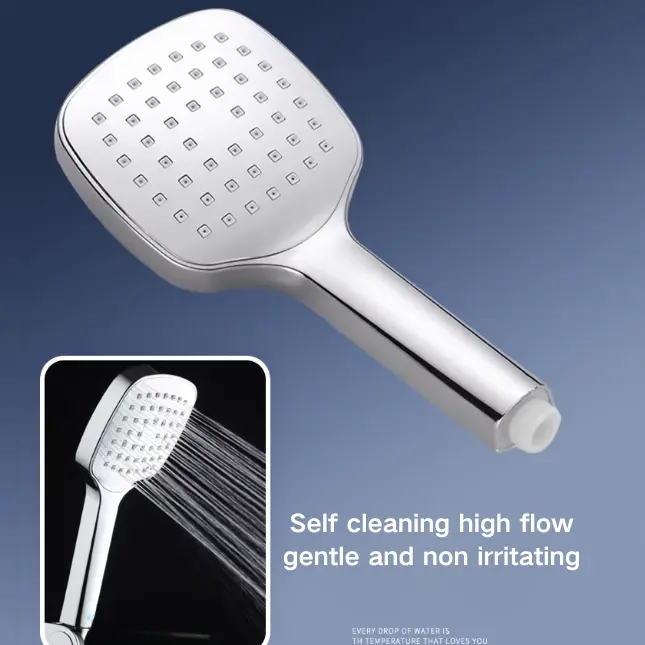
This is also why nozzle design matters in hard water. Self-cleaning silicone jets flex and shed scale rather than letting it harden inside a rigid hole, which keeps the two problems from compounding, as on the Self-Cleaning High Pressure Shower Head.
Partly, and less than people hope.
Rinsing dislodges loose sediment sitting on the surface. That can restore a little flow and buy you time. But most trapped particles sit deep inside the fibre and do not come out. More importantly, rinsing does nothing at all for exhausted carbon media, because chlorine adsorption is chemical, not mechanical.
Treat rinsing as a stopgap when you are waiting on a delivery. It is not a substitute for replacement, and any listing implying a cartridge is indefinitely washable is overselling.
For retailers and hotel operators, the replacement cycle is not a maintenance detail. It is the business model.
A filtered shower head sold without a cartridge supply becomes a one-off sale and, eventually, a disappointed customer. Sold with a reorder path, the same product generates repeat revenue every few months. This is the strongest argument for stocking filtered models over plain ones.
Two practical points. First, match the stocking cadence to local water, not to a generic figure: a hard-water market may need cartridges at twice the rate of a soft-water one, and under-stocking there guarantees complaints. Second, insist on replaceable, not sealed, cartridges, such as the twist-open design on the Water Flow Control PP Cotton Purify Filter Shower. Sealed filters force customers to discard the entire head, which kills the repeat sale and the value proposition at once.
Spares store fine in their sealed packaging in a dry cupboard. Keep them out of a damp bathroom, where cotton can take on humidity before it is ever used.
For the wider picture on what these cartridges do and don't remove, see our complete guide to filtered shower heads and our guide to shower filters for hard water. For clog-resistant spray faces, see the self-cleaning hand shower range.
Water hardness classification and measurement: U.S. Geological Survey, Water Science School, "Hardness of Water".
Chlorine use in public drinking water supplies: U.S. Centers for Disease Control and Prevention, Drinking Water.
Product specifications (5 micron rating, 3 to 6 month filter life, twist-open handle, self-cleaning silicone jets): Huanyu High Pressure Filter Detachable Shower Head.
Send your water conditions, sales channel and price point. We'll recommend the right hand shower types, and get samples to you fast.
Request SamplesNingbo Huanyu Sanitary Ware Co., Ltd. is a hand shower manufacturer in Cixi, Ningbo, the centre of China's shower industry. We have exported for over 6 years, on top of two decades of family manufacturing, and we run as a home-factory group: around 140 workers, 30 specialised factories, 80 lines, and an in-house lab with our own inspection team. We have made 600+ shower products for retail and distributor customers including AUCHAN, B&Q, OBI and Leroy Merlin, and we hold CE, RoHS and ACS certification with a 96-hour NSS salt spray standard and a 2-year warranty on every product.
Talk to us: send an inquiry or WhatsApp +86 138 5780 6071.