
Choose a push-button shower head if its button is easy to reach without loosening your grip. Choose a dial if its selector gives you a clear, comfortable route to your preferred spray. Neither control is automatically more durable or more powerful, and a spray-selection button does not necessarily pause the water.
My first question is how you change settings while rinsing, not how many settings appear on the box. A control can feel pleasant when dry yet be awkward on a mounted handset. Another can be easy to press but require several actions to recover a favorite spray.
- Separate spray selection, pause and temperature control before comparing products.
- Compare the actions needed to reach and recover your usual setting.
- Check the control while water is running, both handheld and in its holder.
- Judge durability from the exact model's evidence, not the mechanism's name.

1. What does each shower head control actually change?
A spray selector changes the water pattern. A pause control reduces or interrupts the flow. A wall mixer controls the hot and cold water supplied to the handset. Those jobs can share a product, but they are not interchangeable.
A button can advance a mechanical selector without electricity. A rotary ring can select fixed spray positions without continuously adjusting flow. The appearance of the control tells you how to move it; it does not fully describe what happens inside. Our water-path explanation shows why the active outlet zone matters.
This distinction changes how I read a product brief. "Three functions plus pause" is clearer than "four sprays" when one position only reduces flow. Likewise, "one-key" needs an explanation: does one press select a pattern, pause it, or cycle through positions?
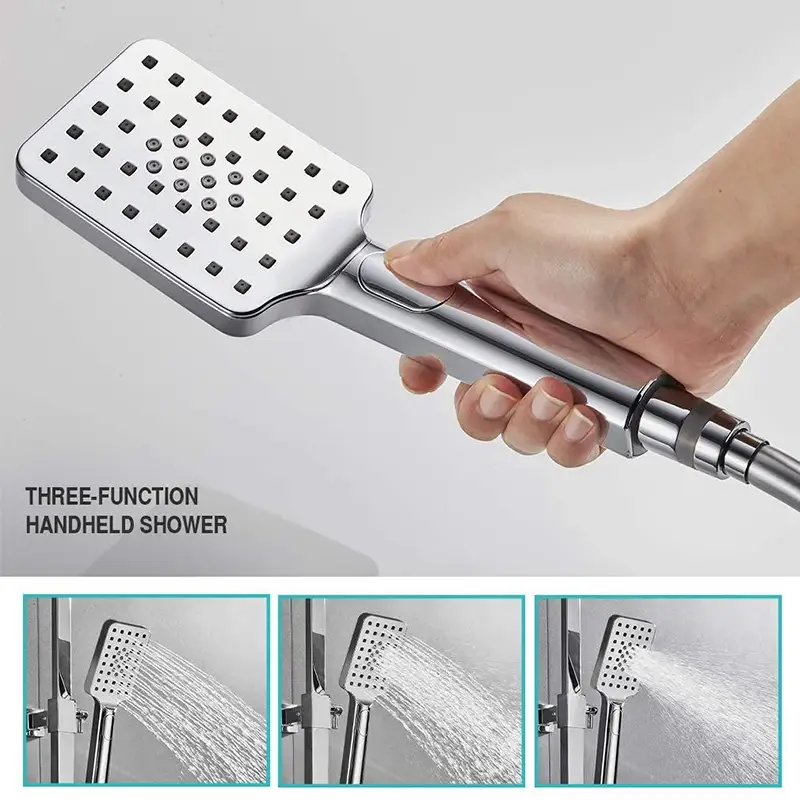
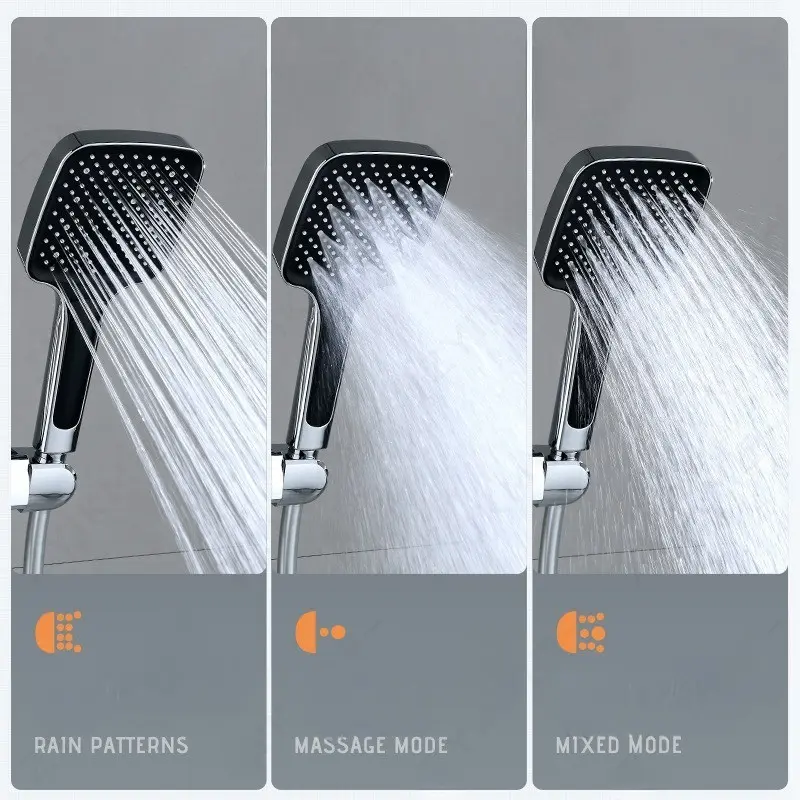
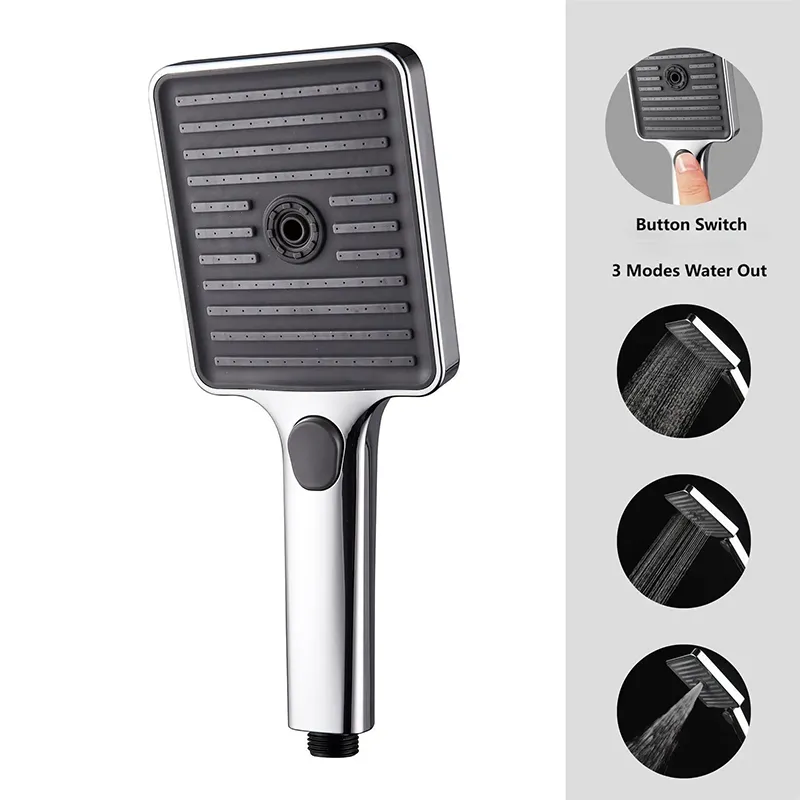
For BHS11001, our product page lists rain, pulse and mixed spray modes, alongside its one-key water-stop feature. Keep those functions separate when comparing it with a regular multi-mode handset. If you want the differences between rain and pulse, use our spray-settings guide; this comparison focuses on reaching those settings.
2. Push buttons vs dials when your hands are wet
A reachable button suits thumb operation while you hold the handle. A projecting dial tab can also be convenient if you can move it without a tight pinch. I would compare both in the position you actually use, rather than declaring every button easier than every ring.
With the handset mounted, the holder may occupy the part of the handle your fingers normally support. With it handheld, pressing a poorly positioned button may shift the spray away from the target. A dial can have a generous tab yet still be awkward if the holder obstructs it. These are reasons to compare the complete handset-and-holder arrangement.
| What to check | Push-button selector | Rotary dial or ring |
|---|---|---|
| Reach | Can your thumb reach the button while maintaining a secure grip? | Can your fingers reach the tab without moving the whole handset? |
| Wet-hand contact | Check the button's surface, height and required travel. | Check tab size and shape; a smooth ring and a projecting lever feel different. |
| Feedback | Does a completed press produce the expected outlet change? | Does the selected position settle clearly rather than remain between settings? |
| Recovering a mode | A cycling button may require further presses after an overshoot. | Reverse selection helps only if the actual design permits it. |
| Mounted use | Check access around the holder and the support needed for pressing. | Check clearance for the full intended selector movement. |
| What cannot be assumed | A button is not automatically electronic, low-force or a pause control. | A dial does not automatically need two hands or offer continuous flow adjustment. |
For accessible projects, measure the action
The U.S. Access Board's operable-parts guidance requires covered controls to work with one hand, without tight grasping, pinching or wrist twisting. It also limits operating force to 5 lbf. This is guidance for elements covered by the U.S. ADA Standards, not a universal product rule for every home.
The same guidance permits certain finger-operated dials when they avoid the prohibited actions. A push button is therefore not proof of accessibility, and the word "dial" is not an automatic disqualification. For a specified accessible bathroom, evaluate the actual control, its operating force, reach and installation together.
3. Count the actions needed to recover your preferred spray
Mode count describes the available choices. Mode sequence describes the work needed to use them. If you mainly alternate between broad rain and a focused rinse, the distance between those settings can matter more than the total number of modes.
Consider an illustrative selector that cycles Rain → Mixed → Massage → Mist → Rain. From Rain, reaching Mist requires three presses if every press advances one position. If a dial with the same circular sequence supports movement in both directions, Rain to Mist could be one reverse move. Those are assumptions for the comparison, not a claimed sequence for a Huanyu model.
Now change the task. If Mixed is your preferred setting, one forward press reaches it from Rain in that example. The button's sequence is no longer a disadvantage. That is why a universal "buttons are faster" or "dials are faster" claim is unhelpful.
My recommendation is to record two transitions: your normal change and your recovery after going one position too far. Include pauses in that record if the pause function shares the selector. Also check the starting mode after stopping and restarting the water; do not assume the handset remembers a position electronically.
For a shared bathroom, put the likely default spray close to an obvious control position. For someone who rarely changes settings, a simple shower head with a clear default can be the more useful choice. Extra modes earn their place only when the user can find them comfortably.
4. A shower head with an on/off switch may still pass some water
Check what "off" means on the exact handset. A pause feature may reduce flow instead of completely stopping it. A small continuing stream can be intentional, rather than evidence that the button or its seal has failed.
The U.S. Access Board's bathing-room guidance describes a non-positive shutoff for the required handheld spray unit. It reduces flow without fully shutting it off, so the main shutoff remains in use. That requirement applies within its accessible-facility scope. It should not be read as a description of every handset sold worldwide.
For everyday use, keep the roles separate: pause is a temporary handset function; close the main faucet after showering. When resuming, direct the spray away from your body and check the temperature before continuing. A handset's pause control is not a thermostatic mixing valve.
Calculate avoided water from the remaining flow
For an illustrative 30-second pause, suppose normal flow is 8 L/min. If pause flow is 0 L/min, the avoided outlet volume is 4 L. If pause flow is 1 L/min, it is 3.5 L instead.
Avoided volume = (normal flow − pause flow) × pause seconds ÷ 60
These examples assume the same 30-second interval would otherwise have run continuously. They are arithmetic examples, not measured Huanyu savings or annual household estimates. They also exclude extra water used after resuming. The residual pause flow belongs in the calculation.
Separate the control from spray performance
EPA WaterSense evaluates spray force, coverage and pressure compensation alongside water efficiency. Its labeled showerheads must use no more than 2.0 gpm and undergo independent certification. The presence of a button, pause position or particular flow number does not establish that certification.
For this comparison, the useful lesson is narrower: measure flow and observe coverage separately from operating the selector. If two modes feel different, the difference may be in the active water path. The button's shape alone does not tell you the spray force.
5. Our factory view: check the water response, not just the click
When we compare a push-button shower head with a rotary selector, we separate two questions: can the user operate it comfortably, and does the water outlet respond correctly? A satisfying click answers neither question completely.
My starting point is the task. Someone rinsing shampoo needs to change the spray without repeatedly adjusting their grip. Someone cleaning a shower enclosure may care more about reaching the control while holding the handset at an angle. These are different demands. I would not recommend a mechanism simply because its showroom sample feels smoother.
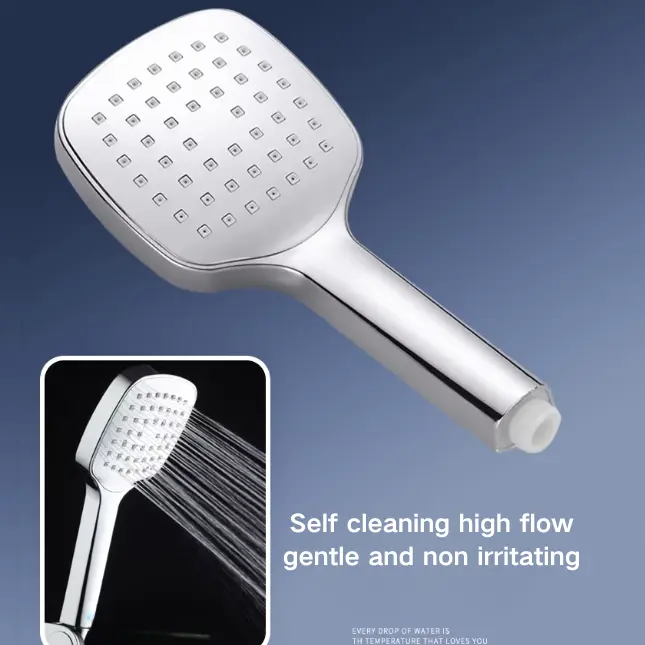
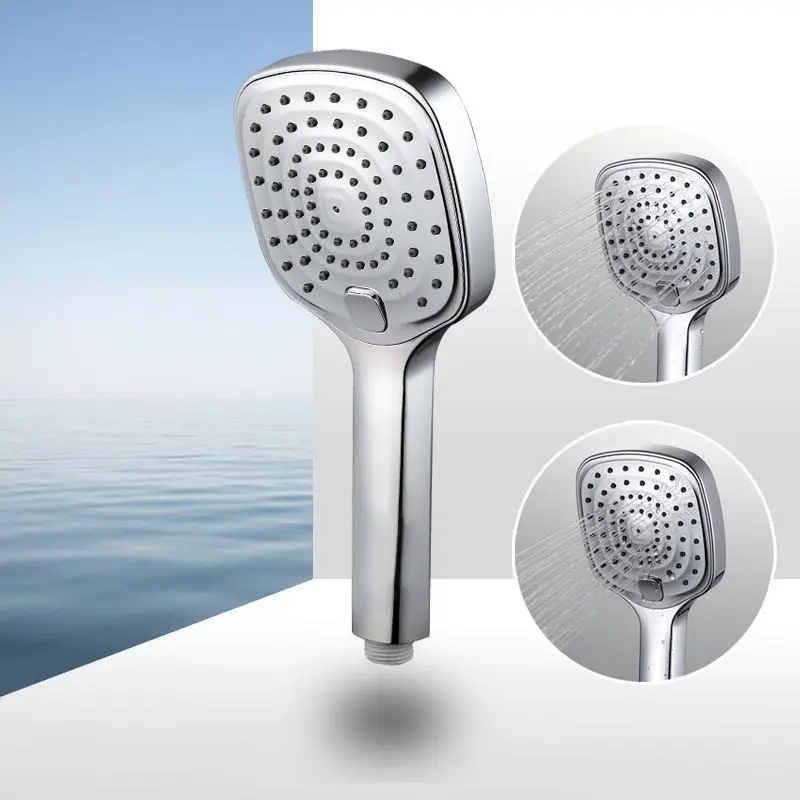
Our BHS11001 push-button hand shower illustrates the design choices involved. Its raised silicone button sits centrally on the handle. The product description lists rain, pulse and mixed spray modes, alongside a one-key water-stop feature. That makes the distinction between spray selection and water control important: buyers need to understand what each action does, not just count the advertised functions.
For sample evaluation, I recommend a repeatable sequence. Run every spray mode. Return to the starting position. Repeat while holding the handset normally, then while it is mounted. Observe whether the outlet changes as expected and whether water appears around the control or housing. Evaluate the pause function separately rather than counting it as another spray pattern.
The BHS11001 specification records 10,000 button presses and water-pressure testing from 0.2 to 0.8 MPa. I treat these as different checks. Repeated actuation evaluates the mechanism; pressure testing evaluates performance under the stated water conditions. Neither figure, by itself, establishes a service life in years.
Our assembly inspection process includes leakage, functionality and appearance checks. My recommendation is straightforward: approve the control together with its water response. A button or dial is useful only when the selected function is clear, repeatable and comfortable to operate.
| Evidence | What it tells you | What it does not establish |
|---|---|---|
| BHS11001: 10,000 press tests | A published actuation-test figure for that button model. | A lifespan in years, a comparison with every dial, or an operating-force measurement. |
| BHS11001: 0.2 to 0.8 MPa pressure testing | The model page's stated test-pressure range. | A recommended pressure for every installation, or proof of easy operation at every pressure. |
| BS EN 1112:2008 | A standard whose public scope covers dimensional, leaktightness, mechanical, hydraulic and acoustic characteristics of shower outlets. | Proof that a particular model passed it, or that a button is better than a dial. |
Model figures: Huanyu BHS11001 specifications. Standard scope: BSI's BS EN 1112:2008 record. A standard's public scope is a reference for what to evaluate, not a substitute for a matching product report.
How to compare two shower-head controls on a sample
Compare complete, correctly installed samples under the same intended supply conditions. Use water at a comfortable temperature and follow each model's instructions. This is a usability and function check, not a laboratory endurance test.
-
Identify the controls
Write down which action selects a spray and which action pauses or adjusts flow. Check the model instructions before operating a control you cannot identify.
-
Start from the same setting
Choose a comparable everyday spray on both samples. Keep the supply setting unchanged during each comparison and note the starting position.
-
Compare handheld and mounted use
With wet hands and a secure grip, operate each control through its intended travel. Repeat in the holder. Note grip changes, clearance and any unintended change in spray direction.
-
Follow the mode path
Reach your preferred spray, then return to the starting setting. Count deliberate presses or selector moves. Observe whether the intended nozzle zone becomes active at each completed position.
-
Check pause separately
If the model has pause, compare the observed remaining flow with its instructions. Resume with the spray directed away from the body, check the temperature and close the main faucet after use.
-
Record the result without forcing a fault
Note sticking, incomplete return, unclear positions or water around the control housing. Stop if operation requires force. Keep the model number, supply conditions and a short operating video with the result.
If an existing control has already stopped changing modes, our button troubleshooting guide addresses that repair question separately. A sample comparison should not turn into forced disassembly.
6. A real quality project: repair the design or change the model?
In one Huanyu shower-product quality project, a long-standing partner reported unexpected problems with a batch of shower units. Our engineering and customer-service teams reviewed the issue together. We developed two routes because retaining the original design and protecting the delivery schedule required different decisions.
The first route was mold modification. Our tooling team conducted dimensional analysis to identify the structural defect. The proposed correction involved targeted CNC adjustments, trial samples and three rounds of quality validation before production release. The estimated schedule was 12 to 15 working days from customer confirmation to revised-batch delivery.
The second route used a compatible model already available in finished stock. Our product team pre-screened three replacement candidates against the original installation dimensions, flow rate and finish specification. This route offered a shipment window of 3 to 5 working days for the selected stocked alternative.
The immediate result was a concrete decision package: one route preserved the original design, while the other prioritized supply continuity. Each option included its own timing and cost implications.
That project explains why we do not regard replacement shower heads as interchangeable merely because their connections fit. For a push-button or dial model, I would also compare the control location, spray-selection sequence and pause behavior. Installation compatibility gets the product onto the hose. Functional compatibility determines whether it remains the right product for the user.
7. Choose for the routine, not for the longest feature list
I would choose the control by the transition used most often. A reachable handle button is attractive when you change spray without changing your grip. A dial with a usable tab can be preferable when it takes you straight back to a familiar setting instead of cycling past several unwanted ones. If the holder blocks that tab, the dial loses that advantage in the installed position.
Washing hair or directing a focused rinse
Check what happens after you go one setting too far, after a temporary pause, and after shutting the main faucet. These are different events. A control can be easy to press yet awkward to recover, and the selected starting pattern may matter more than the feel of its click. Record the actual water response instead of assuming that either mechanism remembers your preferred setting.
Bathing children, pets or helping another person
Keep control of the spray direction while adjusting the setting. A reachable button can be useful, but the handset's weight, grip and hose movement still affect the task. Confirm the selected pattern before directing it toward another person. A pause feature does not replace supervision or checking the water temperature.
Choosing an apartment shower head for unfamiliar users
In a shared or rental bathroom, I favor an obvious starting mode and a control that explains itself through movement and water response. One clear selector can be preferable to several similar-looking buttons. If a user accidentally pauses the water, can they recognize what happened and resume it without operating the wrong control?
Simple shower heads are not necessarily single-mode products. A multi-mode handset can still be simple if the daily setting is easy to find. My preference is to remove uncertainty from operation before adding another spray variation. For an apartment specification, show the holder and control together in the product demonstration, not just a close-up of the spray face.
8. Questions about push-button and dial shower heads
Are all push-button shower heads electronic?
No. A push button can mechanically move a selector or valve without a battery or power supply. Electronic touch controls are a different arrangement. Check the exact product's operating instructions rather than assuming that a button means electronics.
Can a dial shower head be operated with one hand?
Some can. A projecting tab may allow finger operation without a tight grip, while another design may be awkward to turn. Compare the actual selector with wet hands, both handheld and mounted. The U.S. Access Board allows certain finger-operated dials when they avoid prohibited grasping, pinching and wrist twisting.
Does every shower head button pause the water?
No. A button may only change spray settings. Pause can be a separate control or a position in the selection sequence, and some models have no pause function. Check which action changes the spray and which action reduces or interrupts flow.
Why does water still flow when I press pause?
The model may use a pause function that intentionally leaves a reduced flow. The U.S. ADA guidance requires a non-positive shutoff for its covered handheld spray units. Compare the behavior with your exact model's instructions before treating it as a fault, and close the main faucet after use.
Does a push button give more water pressure than a dial?
The control type alone does not establish spray performance. Compare the active outlet pattern and flow under the same supply conditions. EPA WaterSense evaluates spray force, coverage and pressure compensation separately, so a button or dial label is not enough to predict the result.
Are 10,000 button presses the same as a ten-year lifespan?
No. The BHS11001 page's 10,000-press figure describes an actuation test, not ten years of household use. A lifespan claim would need its own supporting conditions and evidence. Do not convert a cycle count directly into years or transfer one model's test figure to a different model.
9. Match a Huanyu control to the way it will be used
Our button-control hand shower range gives you handle-button options to compare with conventional selector designs. Start with the model and the required operation, then check the sample's spray sequence and pause behavior.
BHS11001 pairs a 140 mm head size with its raised handle button and listed rain, pulse and mixed modes. Its product page also describes the one-key water-stop feature and publishes the press and pressure-test figures discussed above. The LHS12009 listing provides a round alternative with a prominent 125 mm size specification and describes button or twist-ring configurations. Specify the control version as well as the model number.
Behind the sample, Huanyu's company profile describes in-house mold design, dimensional checks every 20 minutes during partner injection molding, and water-leak testing of every product before approval. Finished goods come to the central warehouse for sampling inspection and unified packaging. These are practical controls for keeping an approved design consistent beyond the first sample.
Our equipment information covers CNC processing, injection molding, assembly, and sealing and water-flow checks. Through our service team, we can provide technical drawings, product photos and operating videos. For control selection, ask for a video showing the full mode sequence with water running, plus the handset in its intended holder.
Show us the control action you want to improve
Send your reference model, market and intended use. Tell us whether your priority is easier thumb reach, clearer spray selection or a specific pause behavior. We can compare relevant Huanyu configurations and provide the drawings or operating material needed to assess them.
Explore button-control models Discuss a control configuration
Ningbo Huanyu Sanitary Ware Co., Ltd.
info@nbhuanyu.com · +86-13857806071
No. 366, Weier Road, Andong Town, Cixi City, Ningbo, Zhejiang Province, China