What Makes a Truly Healthy Shower Head? From Materials to Filter Cartridges, Explained
2026-08-13
Bathing is the most relaxing moment of the day — but have you ever wondered what "checkpoints" every drop of water from your shower head passes through?
As health awareness grows, "healthy shower heads" have become a new favorite in the sanitary ware market. But the market is a mix of products of varying quality. So what exactly makes a shower head truly healthy? This article explains it from two levels: Material Safety and Filter Cartridge Effectiveness.Part 1: For Ordinary Shower Heads, Material Safety Is the Bottom LineNo matter how fancy the features, a shower head is first and foremost a water-contact system. Water comes into long-term contact with components under high temperature and pressure, and the quality of materials directly determines water safety. To judge whether an ordinary shower head is healthy, check three things first:
1. All water-contact parts must be made of 100% virgin material
Recycled materials are of unknown origin and may contain harmful substances such as heavy metals and plasticizers, which can leach out under hot water flow — the long-term risk cannot be ignored. In a truly healthy shower head, every component that comes into contact with water must be made of virgin material, eliminating risks at the source.
2. All screws must be 304 stainless steel, free of heavy metals
Inferior shower heads often use ordinary iron or alloy screws that rust and release heavy metals when exposed to water. 304 stainless steel is stable, corrosion-resistant, and free of heavy metals — the safe standard for water-contact parts.
3. All rubber components must be certified
If inferior materials are used in sealing rings, hoses, and other rubber parts, harmful substances may be released at high temperatures. Only rubber certified for drinking-water contact should be used, ensuring that every water-contact component is safe and reliable.
In one sentence: If the materials don't pass muster, all the "features" are empty talk. A truly healthy shower head has zero tolerance for risk from the very source.Part 2: Filter Shower Heads — Beyond Material Safety, Look at Real EffectivenessIn recent years, shower heads with filter cartridges have become increasingly popular. On top of solving the raw material issue, the health value of these shower heads depends on the "real skills" of the filter cartridge.
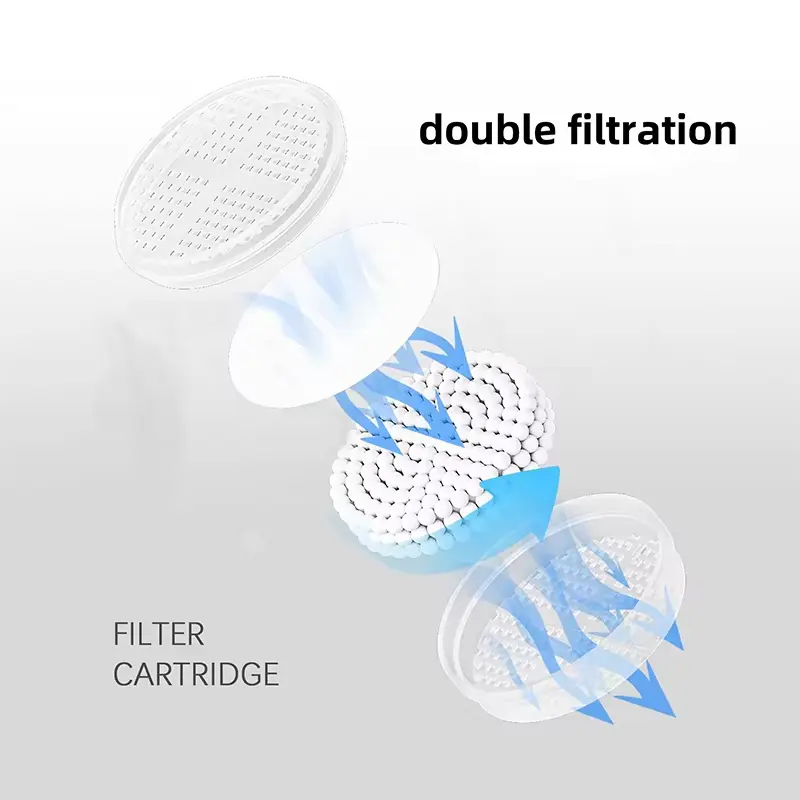
1. Truly effective cartridges rely on three core filter media
The truly effective cartridges on the market today — especially for chlorine removal and water softening — rely mainly on three core filter media:
KDF (high-purity copper-zinc alloy)
● : Removes residual chlorine and heavy metal ions from water efficiently through electrochemical oxidation-reduction reactions, while inhibiting bacterial growth;
Activated carbon
● : With its powerful adsorption capacity, removes residual chlorine, odors, and organic impurities, improving the taste and smell of the water;
Calcium sulfite
● : Offers fast, high-efficiency chlorine removal and is the "main player" among dechlorination media.
2. A well-balanced ratio determines how long the cartridge lasts
A single filter medium has limited capability — the balanced formulation of the cartridge is the key factor determining how long a shower head can maintain effective filtration. A scientifically balanced ratio lets the three media complement one another — adsorption, reduction, and dechlorination working together for more stable performance and a longer service life.
3. Replacement cycle: 3 months is a reference, not a hard rule
The industry generally recommends replacing the cartridge every 3 months. But every family uses the shower differently, and water quality varies by region — households with higher usage frequency and areas with poorer water quality will naturally consume cartridges faster.
Cartridges manufactured to China's national tap water quality standard can generally work for approximately 6,500L. The working principle is removing residual chlorine and impurities from the water. Based on typical household shower water usage, this supports several months of efficient filtration — though the exact interval still depends on your family's actual water consumption.
4. Special case: for groundwater users, PP cotton is recommended
If your home uses groundwater, pairing a PP cotton filter cartridge is the better choice. Groundwater contains more particulate impurities such as sand and rust. PP cotton achieves scale-inhibiting effects through physical interception, preventing impurities from clogging the shower head nozzles — keeping the shower head "unblocked and non-degrading" with smooth, consistent water flow over the long term.Conclusion: The "Three-Step Screening Method" for a Healthy Shower HeadBack to the original question — what makes a truly healthy shower head?
Check the materials
1. : virgin material for water-contact parts, 304 stainless steel screws, certified rubber — eliminate risk at the source;
Check the cartridge
2. : a scientifically balanced combination of KDF + activated carbon + calcium sulfite, delivering up to ~6,500L of efficient filtration per China's tap water standard;
Check the scenario
3. : tap water households focus on chlorine removal and water softening; groundwater households choose PP cotton for scale inhibition and clog prevention.
Healthy shower water starts with a truly healthy shower head.
We use cookies to offer you a better browsing experience, analyze site traffic and personalize content. By using this site, you agree to our use of cookies.
Privacy Policy