
How does a shower head work? Follow one drop from the inlet to the spray
A shower head does not make water. It receives a pressurized supply, meters it, routes it and divides it into streams. The quality of those transitions decides whether the spray feels full, sharp, quiet or uneven.
Water enters through the shower arm or hose connection. A washer seals the joint. Depending on the model, the inlet may contain a screen and flow-control part. Inside the body, a selector sends water to one or more chambers. The spray plate divides that water among its active nozzles, whose size, number, spacing and angle form the final pattern.
Search results for this question often explain the entire shower: hot and cold water meet at the mixing valve, then travel up a pipe. That is correct, but it stops just as the interesting product engineering begins.
The valve controls supply and temperature. The shower head's job starts at its own inlet. From there, the available water must pass through several restrictions and seals before it reaches the face. A multi-function hand shower also has to redirect the water without leaking between inactive outlet zones.
We manufacture hand showers, so we look at the product as a water path first. Styling matters. A shiny face, however, cannot rescue a poor seal, a blocked inlet or a selector that stops halfway between modes.
If you can identify where the water path changes, you can usually explain what the user feels.
A simplified cutaway of a multi-function hand shower
Not every shower head contains every part shown here. The order also varies by design. The diagram shows the jobs that commonly need to happen between the hose and the active nozzle group.
This is an explanatory diagram, not a drawing of one specific Huanyu model. Sealed parts should not be opened unless the product instructions identify them as serviceable.
Follow the water through the shower head
The inlet accepts the supply
A fixed head connects to a shower arm. A hand shower connects to a hose. Threads hold the parts together; the seal normally comes from a washer or another specified sealing surface, not from tightening until the plastic body strains.
The joint has two jobs: keep water inside and present a clear bore. A folded washer, off-center screen or piece of installation debris can reduce the inlet before water reaches any spray mechanism.
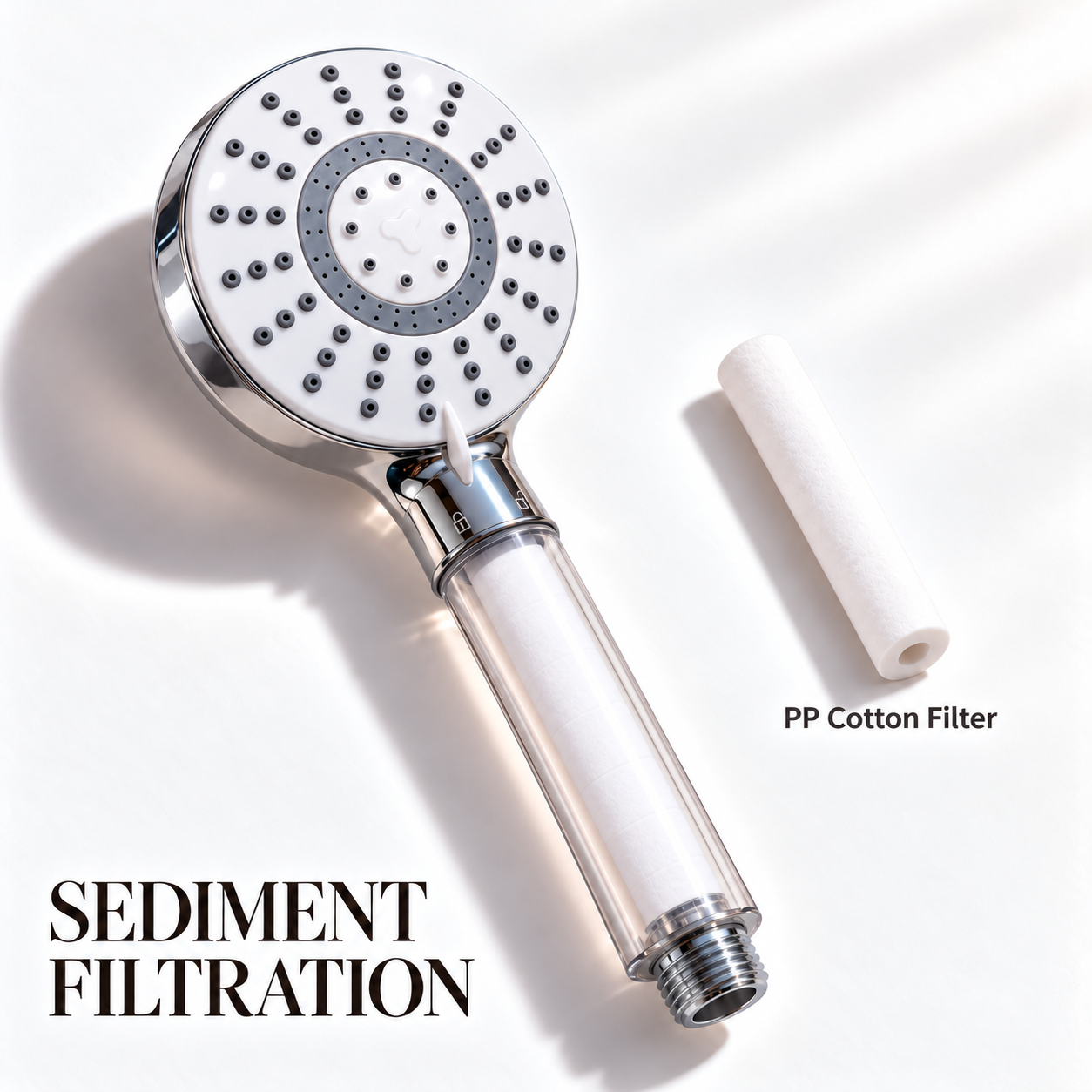
The screen catches larger debris
Some heads or hose washers include a mesh screen near the connection. It protects small passages farther downstream. The screen is useful precisely because it can collect material, which also makes it an early place to inspect when every spray mode becomes weak at once.
A screen and a flow restrictor are not the same part. The screen filters particles. A flow-control insert manages volume. Some assemblies combine several functions closely enough that a quick glance can be misleading.
The flow-control part meters volume
A shower head may use a fixed or pressure-compensating flow-control element. Its job is to keep the delivered flow within the product's intended range. It cannot raise the pressure in the plumbing upstream.
This distinction matters when a new head feels different. A smaller or better-focused spray can feel more forceful even while the head passes less water. If you need to measure the actual delivery, use a timed container test rather than judging by skin sensation. Huanyu's guide to measuring shower water use shows that calculation.
The selector chooses an outlet zone
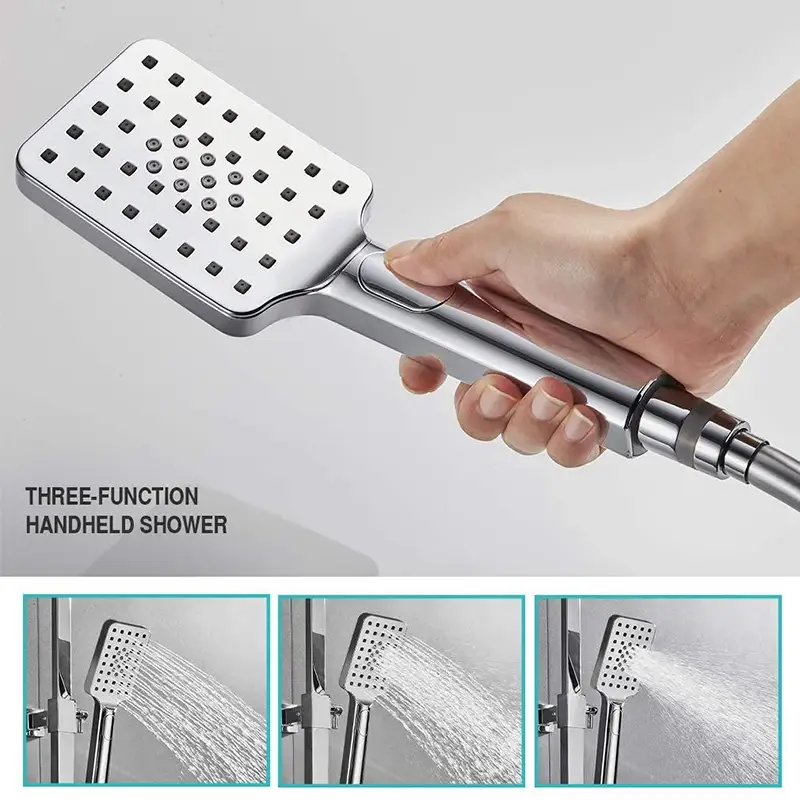
A single-function head may feed one chamber directly. A multi-function head needs a moving selector. Turning a dial, pressing a button or sliding a control changes which internal ports line up with the inlet.
Good switching has a definite end position. If the selector rests between ports, two zones may receive partial flow. The result can look like a weak mixed mode even when supply pressure is normal.
The chamber distributes water behind the face
The selected chamber spreads water across the active section of the spray plate. Chamber depth, ribs, seals and port positions affect how evenly the outlets are fed.
This is where a head can have strong total flow but a poor pattern. If the chamber favors one side, some nozzles receive more water than others. An internal seal leak can also feed a supposedly inactive zone.
The nozzles turn volume into a spray pattern
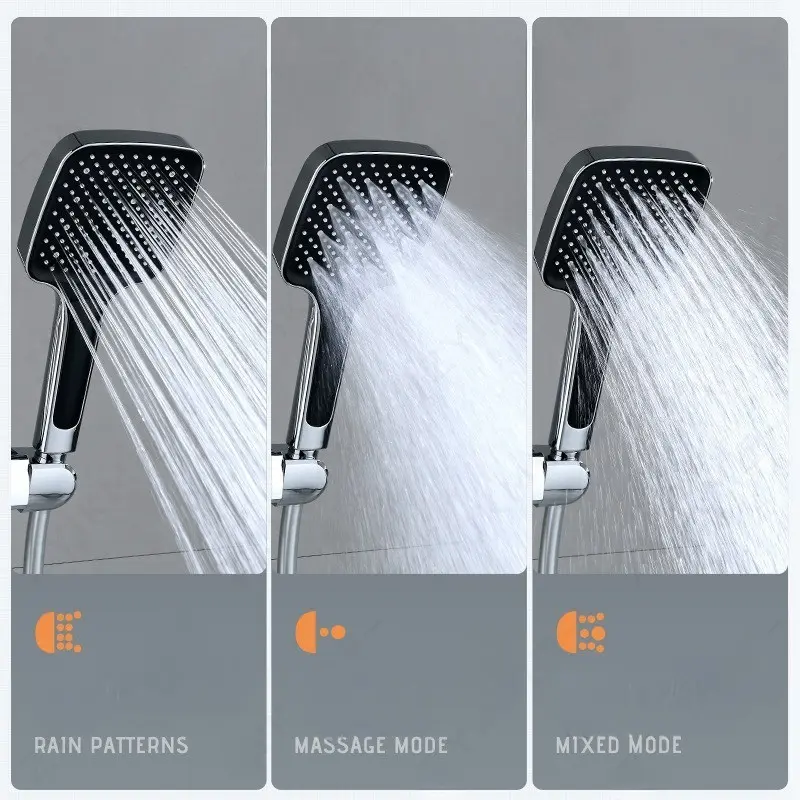
Each open nozzle divides and directs part of the available flow. Fewer active outlets can create a more concentrated pattern. More outlets can widen coverage, but each stream receives only part of the total water.
Outlet diameter, length, direction and spacing all matter. Flexible silicone outlets also make mineral deposits easier to disturb by rubbing the face. A blocked group changes both coverage and perceived force.
Pressure, flow and spray force are different
These terms are often used as if they mean the same thing. They do not. Keeping them separate makes product comparisons and troubleshooting much more useful.
Pressure
Pressure is supplied by the plumbing system while water is flowing. A shower head can spend that pressure through restrictions and outlets. It cannot repair a weak building supply.
Flow rate
Flow rate tells you how much water passes in a set time, commonly gallons or liters per minute. The inlet, control parts and active outlets all influence the result.
Spray force and coverage
Two heads at the same flow can feel different because one concentrates water while another spreads it. Stream size, direction and the active face area change the sensation.
The U.S. EPA WaterSense program treats these as separate performance questions. Its showerhead criteria cover maximum flow, minimum flow across pressure conditions, spray force and spray coverage. WaterSense-labeled showerheads use no more than 2.0 gpm, but the program does not judge performance by flow rate alone.
How multi-function shower heads change modes
Rotating dial or lever
The user turns the face ring or a lever.
The control rotates a plate or selector so different ports line up. Detents can give each mode a defined stop. Deposits, swelling seals or worn contact surfaces may make the control stiff or vague.
The printed mode name is less useful than observing which nozzles become active. Our separate guide to shower-head spray settings compares rain, jet, pulse, mist and mixed patterns.
Push-button control
The user changes the water path with a thumb press.
Depending on the design, the press can index a selector to the next port or actuate a valve directly. Button travel, return action and the resulting nozzle zone all need to agree.
A click does not prove the water path changed. If the control feels normal but the same outlets remain active, use the button troubleshooting sequence before replacing the whole unit.
Stepless adjustment
The user slides or turns through a continuous range.
A stepless design changes the opening or distribution continuously instead of jumping only between fixed detents. This lets the user stop between two end conditions.
That also changes the evaluation. We look for a smooth, repeatable transition and a stable spray across the travel. Checking only the two end modes can miss a rough or unstable section in between.
Pause function
The control temporarily reduces or interrupts outlet flow.
A pause button belongs to the shower head, downstream of the main mixing valve. It should not replace shutting off the faucet after use.
Some standards describe pause as a non-positive shutoff, which allows a small continuing flow. The exact behavior is product specific, so the manual and market requirements control.
Two Huanyu products show why the control changes the water path
Both examples are handheld ABS products with chrome surfaces, yet the user interaction and internal routing job are different.

BHS11004
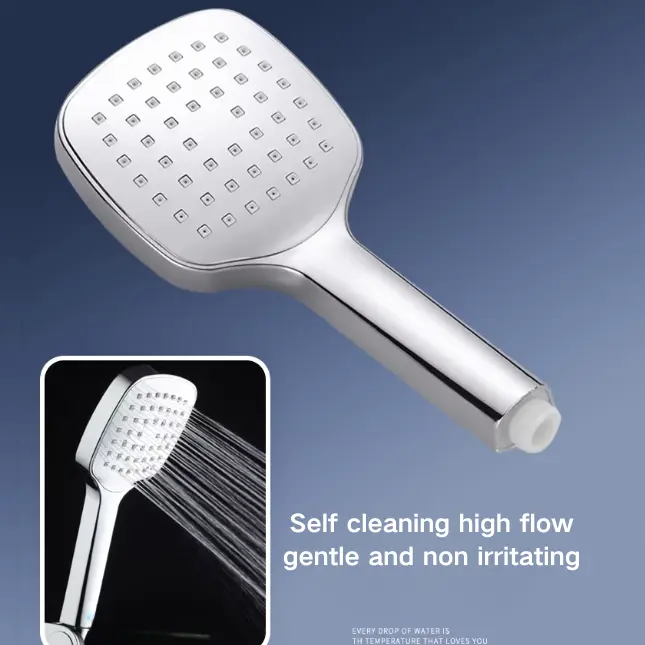
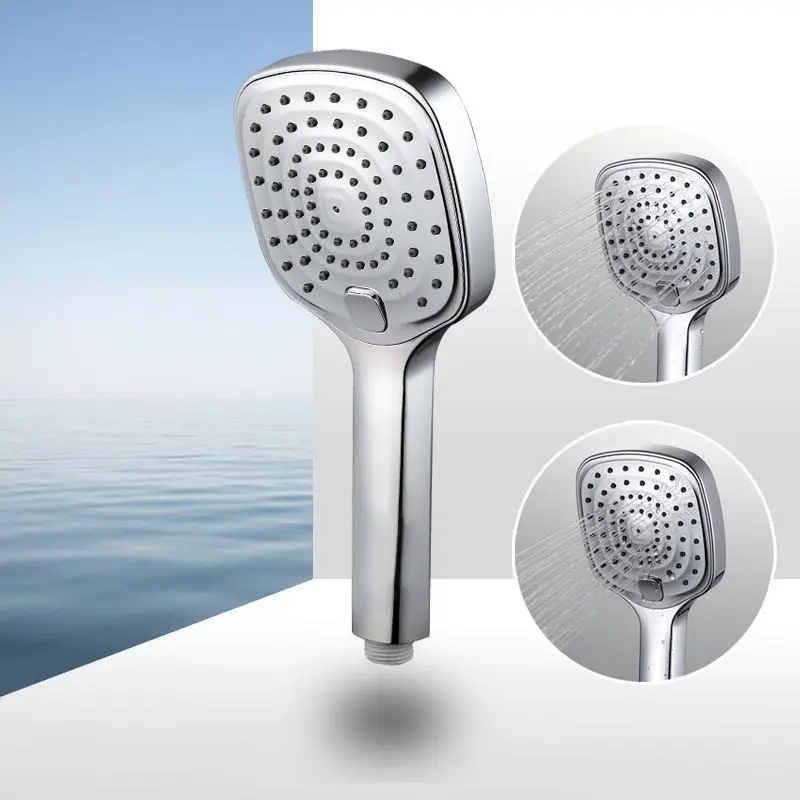
The current product page lists a 130 mm ABS hand shower with a chrome surface and push-button switching between multiple spray modes.
View the BHS11004 product page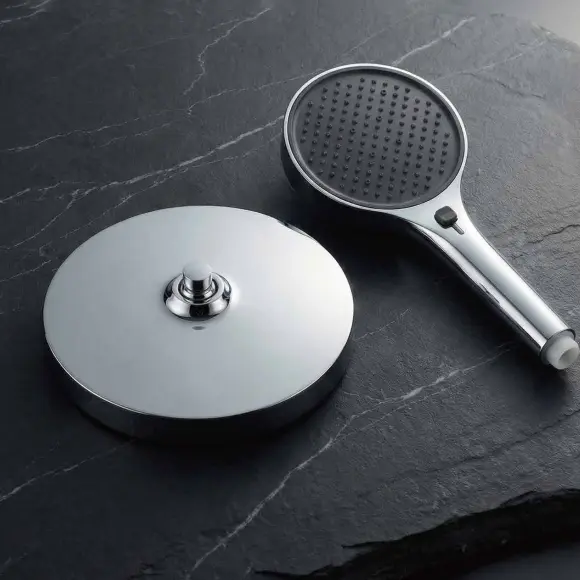
SFC-HS0107
The current product page lists a 140 mm ABS hand shower with a chrome surface, stepless control and self-cleaning silicone nozzles.
View the SFC-HS0107 product pageUse the symptom to locate the water-path address
You do not need to see every hidden part to narrow the fault. Change one condition at a time and notice whether the problem affects the whole head or one outlet zone.
| What you observe | Likely section to inspect | Why it points there | First safe check |
|---|---|---|---|
| All modes are weak | Supply, hose, inlet screen or common flow-control path | The fault appears before the water divides into modes | Compare outlet flow with the head removed, then inspect accessible inlet parts |
| One mode is weak | Selector port, one chamber or one nozzle group | Other water paths still receive normal flow | Cycle fully into the mode and clean its active nozzle zone |
| Inactive nozzles keep spraying | Selector alignment or chamber seal | Water is crossing into an outlet zone that should be closed | Move through the full control travel and check repeatability |
| Leak at hose or shower arm | Threaded inlet, washer or sealing face | The leak forms before water enters the body | Check washer position, sealing surfaces and the specified tightening method |
| Uneven pattern across one face | Nozzles or distribution chamber | Water reaches the head but does not divide evenly | Clean the face and compare cold and warm operation |
| Whistle only with the head fitted | Local restriction, selector position or narrow passage | Water becomes noisy as it accelerates through a particular restriction | Confirm the control is fully seated, then inspect the inlet and nozzles |
| Button clicks but spray does not change | Link between button and selector | The external motion is not producing the expected port change | Observe button return and active nozzle zones under running water |
When the head is removed and flow from the hose or arm returns to normal, the restriction is probably in the removable device. If flow is still weak, continue upstream. Huanyu's shower-pressure diagnosis guide separates head, hose, valve and supply faults.
Before taking anything apart
Service the accessible layer first
Many modern heads use clipped, welded or sealed internal assemblies. Opening one without instructions can damage the face seal, selector timing or surface finish.
Start outside. Shut off the faucet, protect the finish, and follow the model instructions. Clean the nozzles. Check the removable inlet washer or screen if the design permits. Flush loose debris without forcing tools into calibrated parts.
If the body seam leaks, a button no longer returns or the selector will not hold a mode, replacement or manufacturer service may be more reliable than improvised disassembly.
At the factory, we test the path rather than the shell
Huanyu's published equipment page lists sealing and pressure test equipment that simulates 0.3 to 1.0 MPa, plus water-flow and noise testing equipment. Those checks address different failure points.
Look for water escaping at joints, seams and inactive internal paths.
Measure delivered volume under a defined inlet condition instead of judging by appearance.
Check whether active outlets produce the intended coverage and whether zones switch cleanly.
Listen for whistle, chatter or unstable behavior that appears only at certain controls or pressures.
The useful factory question is not "Does water come out?" It is "Does the correct water path remain stable across the intended operating conditions?"
Developing a hand shower? Specify the internal job before the exterior
Huanyu manufactures button-control, stepless, self-cleaning, 3D, spa and regular hand showers. Send us the intended inlet connection, market flow target, control method, active nozzle zones, mode sequence, face size and finish.
We can discuss the product around its complete water path, including molding, assembly, sealing and pressure testing, water-flow evaluation and noise testing shown on our current equipment page.
How shower heads work: common questions
What parts are inside a shower head?
A typical shower head has an inlet and seal, a body, water chambers, a spray plate and nozzles. Depending on the model, it may also contain an inlet screen, flow-control part, selector, seals, springs or other control components. The exact order is product specific.
Does a shower head increase water pressure?
A shower head cannot increase the building's upstream water pressure. It can change how the available water feels by controlling flow, reducing outlet size, concentrating the active nozzle area or shaping the spray. A more forceful sensation is not proof that supply pressure increased.
How does a multi-function shower head change spray settings?
A dial, lever, button or slider moves an internal selector. The selector aligns the inlet with different water chambers, which feed different groups of nozzles. Each active group creates its own spray shape or rhythm.
What does the flow restrictor in a shower head do?
A flow restrictor or regulator controls how much water can pass through the head under its intended conditions. It is different from a mesh screen, which catches debris. Their appearance and location vary by product.
Why is one shower-head setting weaker than the others?
If other modes remain strong, the fault is probably downstream of the common inlet. The selector may not be fully aligned, one chamber may leak, or the active nozzle group may be blocked. Cycle the control fully and clean that nozzle zone before blaming the home supply.
Why do silicone shower-head nozzles help with cleaning?
Flexible silicone outlets can be rubbed or flexed to disturb mineral deposits at the spray face. They do not remove minerals from the water, and internal passages can still collect debris or scale.