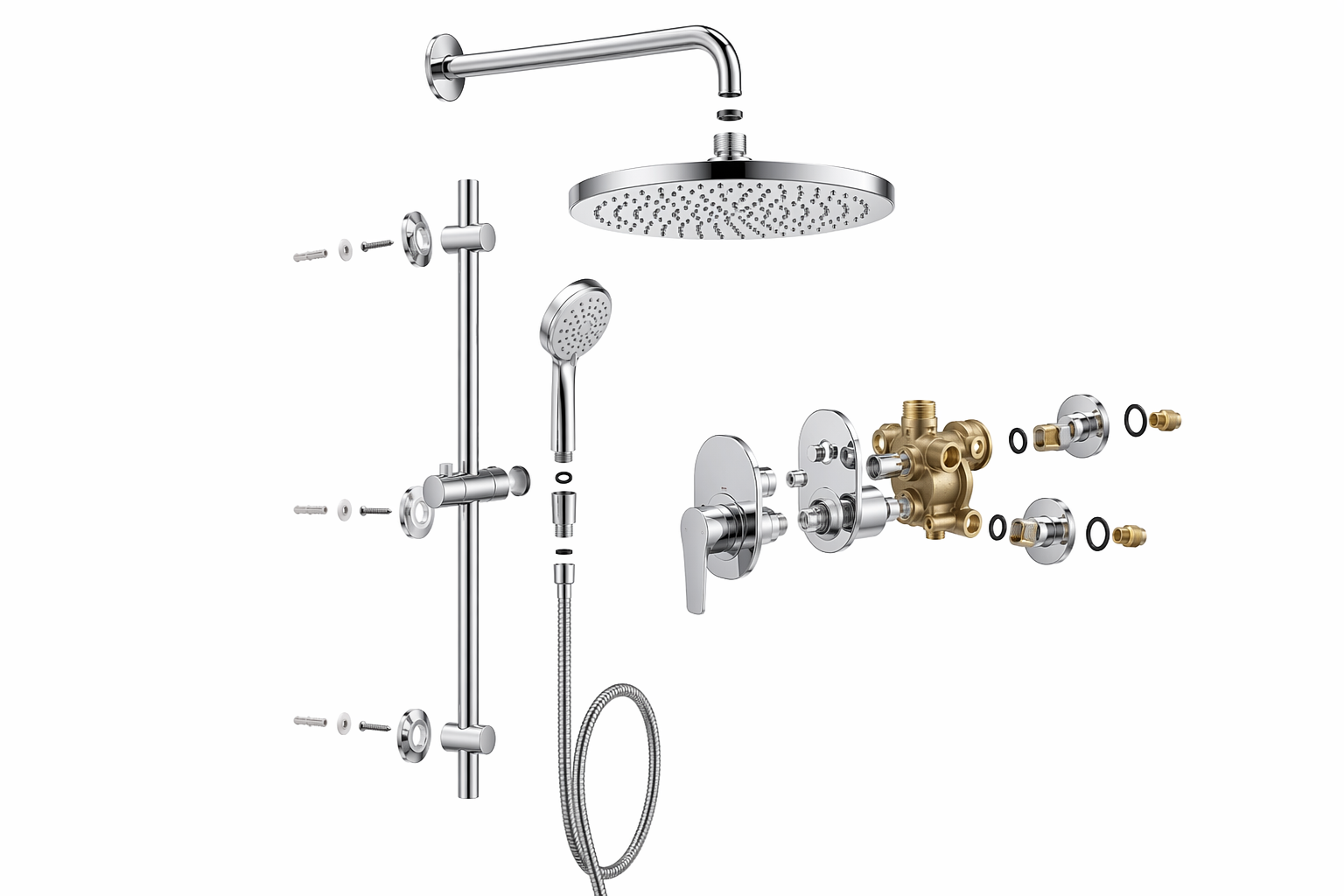

How much water does a shower use? Stop guessing—measure your actual flow
An “average shower” is not your shower. Water use depends on the flow delivered at your selected setting, the minutes water actually runs, and whether you include the warm-up period.
An eight-minute shower uses 16 gallons at 2.0 gpm or 20 gallons at 2.5 gpm. In metric units, that is about 60.6 or 75.7 liters. Use the calculator below with your measured flow—not a generic average—for a result that applies to your bathroom.
Shower water usage calculator
Enter a measured or rated flow, the time water runs, the number of showers per person each week, and the number of people. The calculator converts gallons and liters automatically.
Calculation uses 52.1429 weeks per year and 12 months per year. It estimates water volume only; it does not estimate local water, sewer or heating cost.
The most useful answer is an equation, not an average. The 2016 Water Research Foundation study reported an average shower duration of 7.8 minutes. Its widely cited residential results put shower flow near 2.1 gpm and average volume near 15.8 gallons, but the study focused on single-family residences in North America. It is a benchmark, not a meter reading for your home.
Google's first page commonly rounds the answer to about 17 gallons over roughly eight minutes. That is easy to remember. It also hides the variable that matters most: your delivered flow can differ because of the shower head, supply pressure, valve position, spray mode, deposits and simultaneous water use elsewhere in the building.
If you want to compare habits, use the same measured flow for each calculation. If you want to compare shower heads, measure each one under the same valve position, pressure conditions, temperature mix and test method.
What the first page misses
A rated maximum is not a personal water-use result
U.S. federal rules set a maximum of 2.5 gpm for covered showerheads when measured at a flowing pressure of 80 psi, as stated in 10 CFR 430.32(p). That is a controlled compliance value. It does not mean every shower delivers exactly 2.5 gallons each minute in every bathroom.
The EPA WaterSense program requires a rated flow of no more than 2.0 gpm and also addresses spray force, spray coverage and minimum flow across different pressures. That distinction matters: reducing volume is only one part of designing a satisfying spray.
For household calculation, use the product label as a starting estimate. Replace it with an in-place measurement when you need a real answer.
Quick reference: water used at steady flow
These values are pure multiplication. They assume the water runs continuously at the stated rate.
| Flow rate | 5 minutes | 8 minutes | 10 minutes | 15 minutes |
|---|---|---|---|---|
| 1.5 gpm / 5.7 L/min | 7.5 gal / 28.4 L | 12 gal / 45.4 L | 15 gal / 56.8 L | 22.5 gal / 85.2 L |
| 1.8 gpm / 6.8 L/min | 9 gal / 34.1 L | 14.4 gal / 54.5 L | 18 gal / 68.1 L | 27 gal / 102.2 L |
| 2.0 gpm / 7.6 L/min | 10 gal / 37.9 L | 16 gal / 60.6 L | 20 gal / 75.7 L | 30 gal / 113.6 L |
| 2.5 gpm / 9.5 L/min | 12.5 gal / 47.3 L | 20 gal / 75.7 L | 25 gal / 94.6 L | 37.5 gal / 142.0 L |
Measure your real shower flow in place
You need a container with reliable volume marks and a timer. A larger collection volume reduces the effect of starting and stopping the timer a fraction of a second early.
- Choose the spray mode and flow-control position you normally use.
- Run the shower until the temperature and visible flow stabilize.
- Place the container under the complete spray. Start timing when collection begins.
- Collect for 15 or 30 seconds, then read the volume on a level surface.
- For a 15-second test, multiply the volume by four. For 30 seconds, multiply by two.
- Repeat the test twice. If the results differ noticeably, run a longer collection and check whether another fixture or a pressure cycle is changing the flow.
Three calculations that are more useful than “the average shower”
Break a shower into periods whenever the flow changes. Multiply the flow for each period by its running time, then add the volumes. A true pause contributes zero; warm-up water still counts.
One steady setting
2.0 gpm × 8 min = 16 gal
This is the standard calculation. It is useful before purchase or when no measuring container is available, but it assumes the installed product delivers its labeled rate continuously.
Measured household use
1.7 gpm × (0.75 + 7.5 min) = 14.0 gal
The shower runs for 45 seconds before entry and 7.5 minutes during use. Omitting warm-up would report 12.75 gallons and miss 1.275 gallons per shower.
Two active flow positions
(6 L/min × 3 min) + (8 L/min × 4 min) = 50 L
A lathering pause between the two periods adds no volume if flow truly stops. If the pause control leaves a residual stream, measure that rate and add it as a third segment.
What your measurement can—and cannot—diagnose
A bucket result describes delivered flow at one moment. Compare repeat tests before deciding that the shower head, plumbing or label is wrong.
| What you observe | What it may mean | Next check |
|---|---|---|
| Repeated results are close | The installed system is delivering a stable flow under those test conditions. | Record pressure conditions, valve position, temperature mix and spray mode so the result can be repeated. |
| Measured flow is below the rated maximum | This can be normal. The rating is a controlled maximum, while the home may have lower pressure or additional restrictions. | Check other modes, clean the nozzles, inspect the hose and compare with the manufacturer's operating conditions. |
| One spray mode is much lower | A smaller internal passage may be intentional, or one channel may be partially obstructed. | Follow the cleaning instructions and repeat the same mode. Do not compare different patterns as though only volume changed. |
| Flow rises and falls during collection | Another fixture, a pump cycle, valve movement or supply-pressure change may be affecting the test. | Test when other fixtures are off, collect for longer, and note whether the fluctuation repeats at a regular interval. |
| Measured flow appears above the label | The collection volume, timing, unit conversion, product configuration or label identification may be wrong. | Use a larger calibrated container, repeat for at least 30 seconds and confirm the exact model. Treat compliance as a controlled laboratory question, not a single bucket result. |
Four volumes most shower calculators leave out
Warm-up water
If the shower runs for 45 seconds before you step in, add 0.75 minute at the measured warm-up flow. This volume still reaches the drain unless it is collected for another use.
Paused water
A real pause button may reduce or stop flow while lathering. Time the active periods separately. Do not count the entire bathroom occupancy time as full-flow time.
Different slider positions
A stepless control can create several flow periods in one shower. Calculate each segment, then add them: low flow × minutes plus high flow × minutes.
More than one outlet
If an overhead and hand shower run together, measure their combined outlet flow. Adding individual label ratings can overstate or understate the delivered result when the supply is shared.
Why a factory does not test flow with a kitchen bucket alone
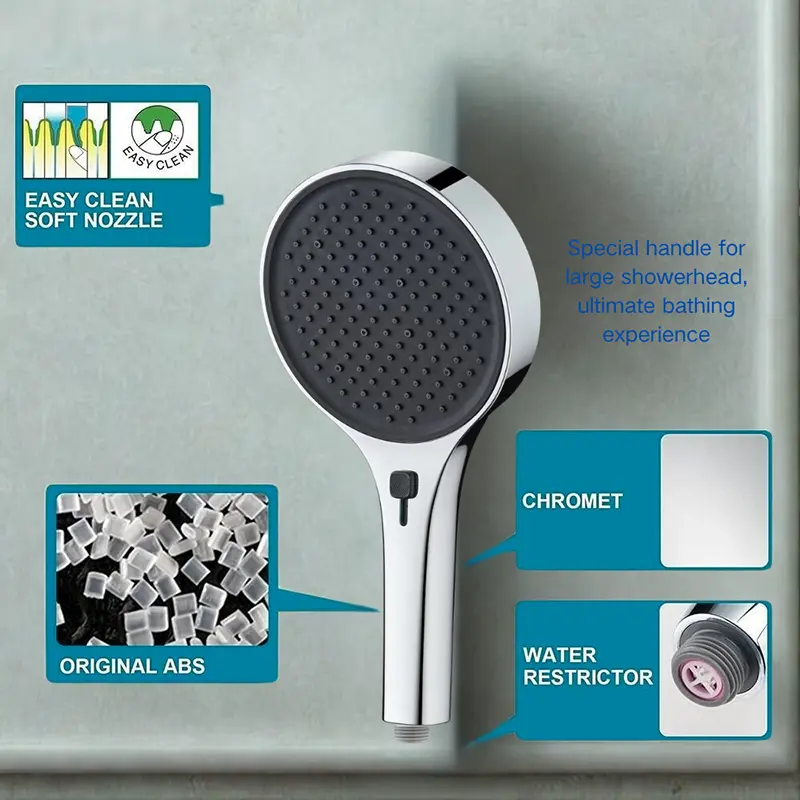
The bucket method is excellent for a household answer because it captures the shower as installed. It is not enough for product approval. A factory needs controlled inlet pressure, repeatable temperature and test duration, calibrated flow measurement, the correct product configuration, and a record of the selected mode.
Huanyu's equipment page describes sealing and pressure testing from 0.3 to 1.0 MPa, plus equipment for water flow, spray uniformity and noise. We keep these checks separate because one number cannot describe the entire shower experience.
- Flow records water volume per unit of time.
- Pressure is a condition at the inlet, not a synonym for flow.
- Coverage shows where the spray lands across the target area.
- Uniformity reveals whether the spray is balanced or has weak zones.
A good product decision therefore asks two questions: how much water is delivered, and what the shower head does with that water.
Real product example
With stepless control, the user's setting becomes part of the data
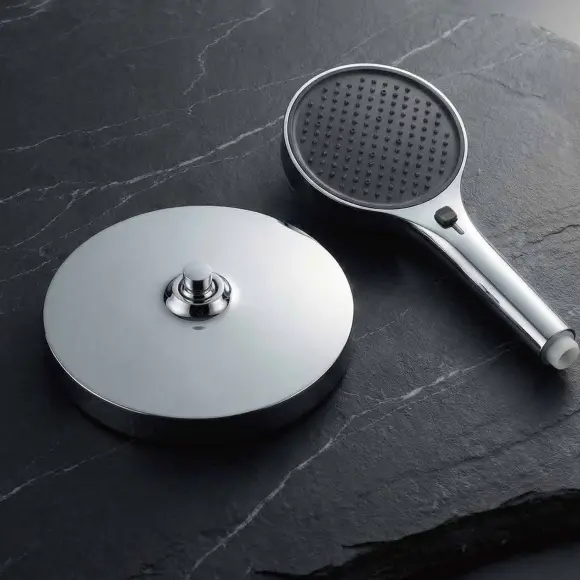
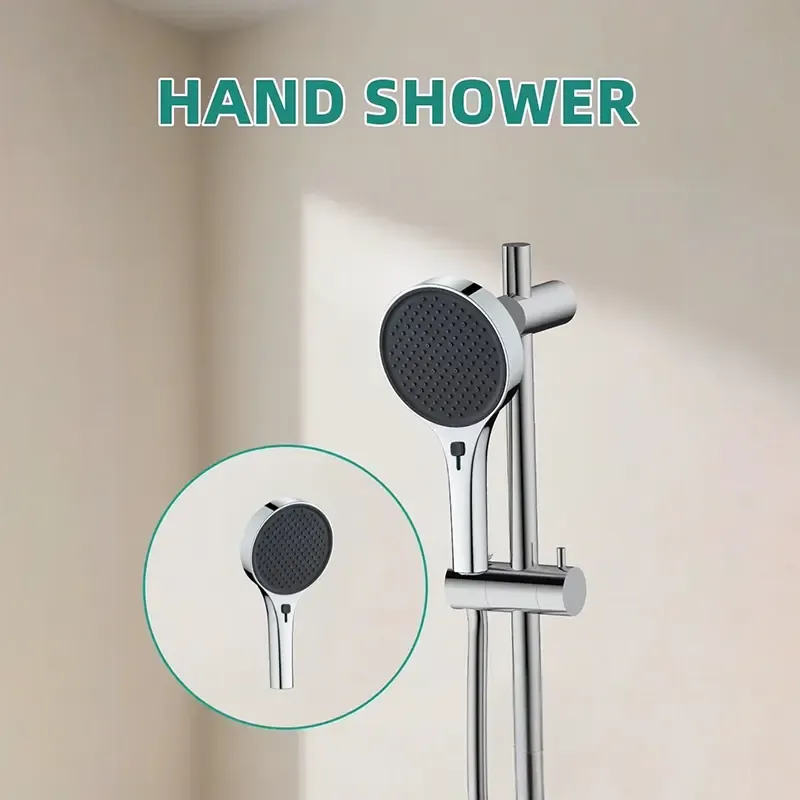
Huanyu's SFC-HS0107 Multi-functional Stepless Speed Adjustable Water Saving Shower uses a sliding control rather than only fixed numbered settings. Its product page lists a 140 mm ABS hand shower with a chrome finish and describes a dynamic flow-limiting and stabilizing device for operation across 0.1–0.8 MPa.
For this kind of control, one label cannot tell you how much water a person chooses to use. Our practical recommendation is to measure three positions—low, preferred and full—and document the control position used for every comparison. That produces a useful range instead of a misleading single household estimate.
What to change after you know your number
Do not begin by removing parts or buying the lowest-flow product you can find. First decide whether the problem is total volume, weak cleaning performance, excessive warm-up waste, or an unstable spray.
Test a shorter running time or a properly specified efficient shower head. Compare at the same supply conditions and verify that coverage still suits the user.
The shower head is not the only lever. Track active water time, use a timer, or pause while lathering. Reducing minutes changes volume in direct proportion.
Measure this volume separately. The cause may be pipe length, water-heater location or recirculation strategy rather than the shower head.
Inspect for blocked nozzles, a restricted hose, partly closed valve or pressure issue before assuming the rated flow is wrong. Huanyu's guide to shower pressure troubleshooting covers that diagnosis.
You may already have an efficient combination. Record the result and keep the nozzles clean rather than chasing a higher number.
Frequently asked questions
How much water does an eight-minute shower use?
An eight-minute shower uses 16 gallons at 2.0 gpm or 20 gallons at 2.5 gpm. That is approximately 60.6 or 75.7 liters. Use measured flow for a result that reflects your installed shower.
How many gallons does a five-minute shower use?
Multiply the shower head's flow in gallons per minute by five. A 1.5 gpm shower uses 7.5 gallons, a 2.0 gpm shower uses 10 gallons, and a 2.5 gpm shower uses 12.5 gallons.
How do I measure my shower head's GPM?
Collect the complete spray in a marked container at your normal setting. If you collect for 15 seconds, multiply the measured gallons by four. Repeat the test and use a longer collection if the two results differ noticeably.
Does lower water pressure always mean lower shower water use?
No simple rule covers every installation. Delivered flow can change with pressure, but the shower head's regulating structure, valve position, pipe restrictions and simultaneous fixture use also matter. Measure the installed shower rather than estimating volume from pressure alone.
Does a WaterSense shower head use 2.0 gallons every minute?
WaterSense requires a rated maximum flow of no more than 2.0 gpm and includes performance criteria across specified test pressures. The actual flow in a home can be lower and should be measured under the user's normal conditions.