
A single-function shower head is often the better daily choice when one well-designed spray covers the tasks you actually perform. A multi-function head earns its extra mechanism when its settings deliver meaningfully different coverage or rinsing power and you can switch between them easily.
Compare the default setting first, then test whether a second setting solves a different job: a focused rinse, a gentler spray or cleaning the enclosure. If you would leave the selector untouched, I would prioritise the quality of that default spray over extra positions.
- One excellent default spray can be more useful than five settings that feel alike.
- More modes do not automatically mean higher water pressure or greater water use.
- A selector adds convenience and another part to inspect, clean and operate.
- For a shared bathroom, two distinct spray jobs can justify a multi-function model.
- Flow, spray force and coverage need separate checks; mode count measures none of them.
What does “function” mean on a shower head?
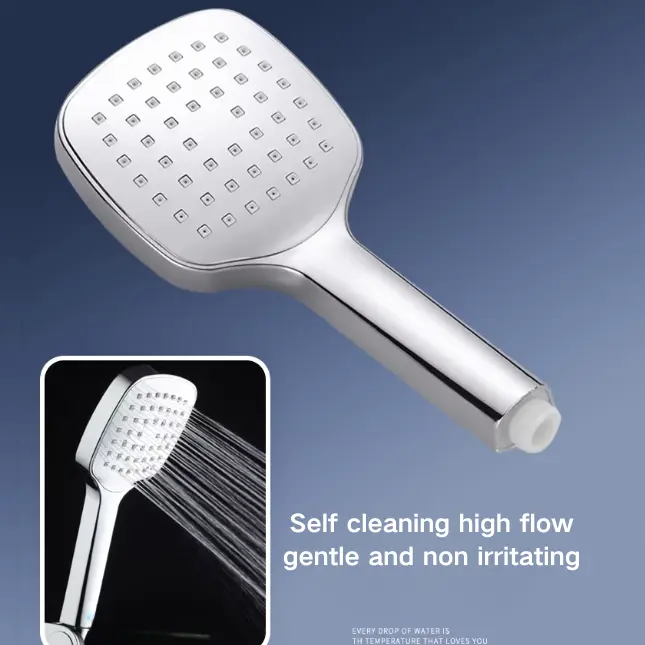
A single-function head sends water through one intended spray pattern. It can still have a large face, a small face, soft outlets or a focused pattern. “Single-function” describes the available spray choice, not the build quality or the size of the head. Some people want exactly this: turn the water on and receive the same predictable spray every time.
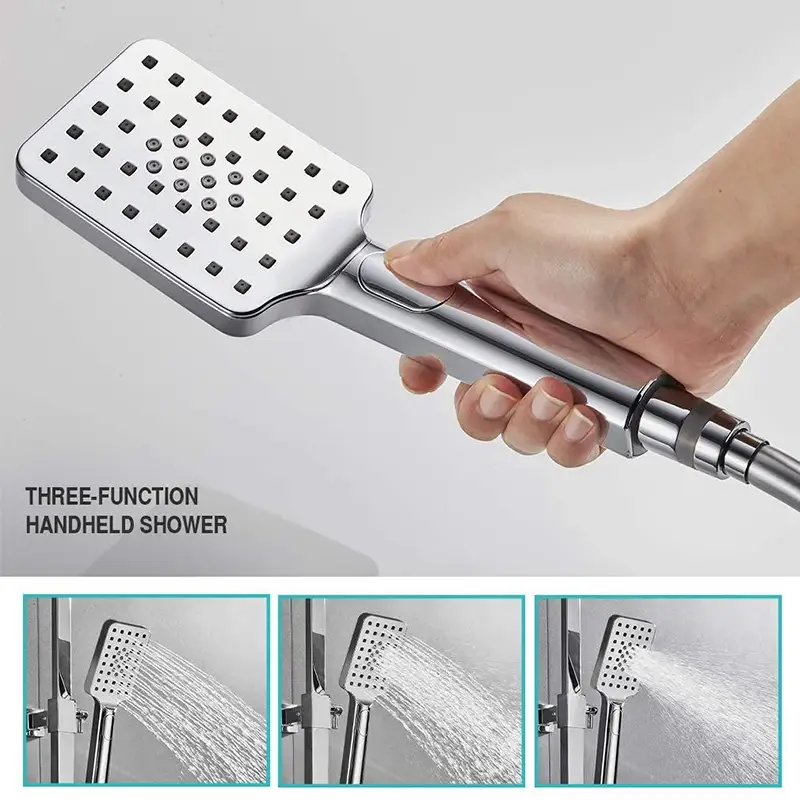
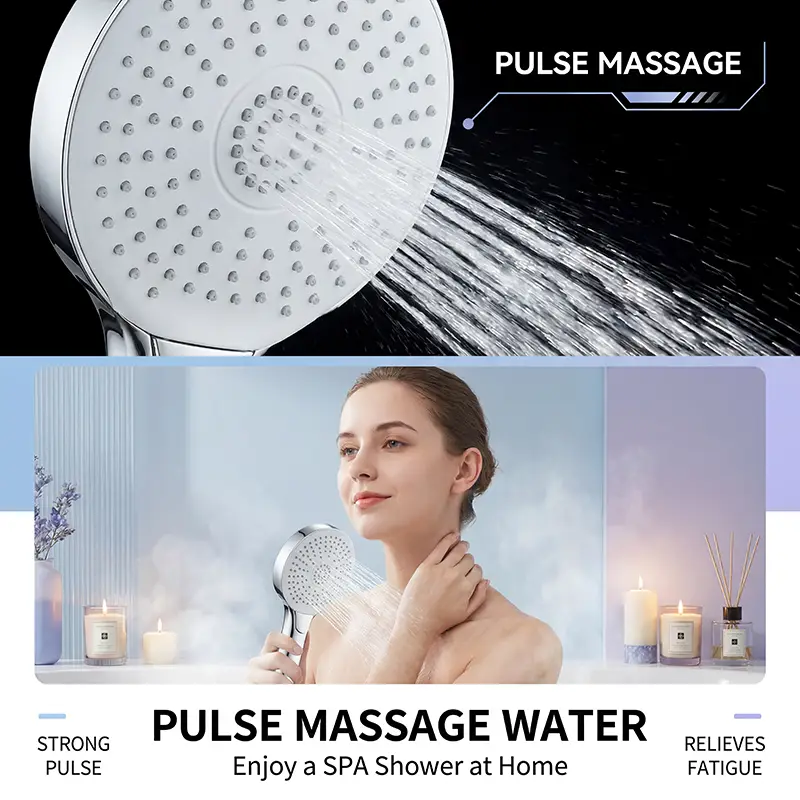
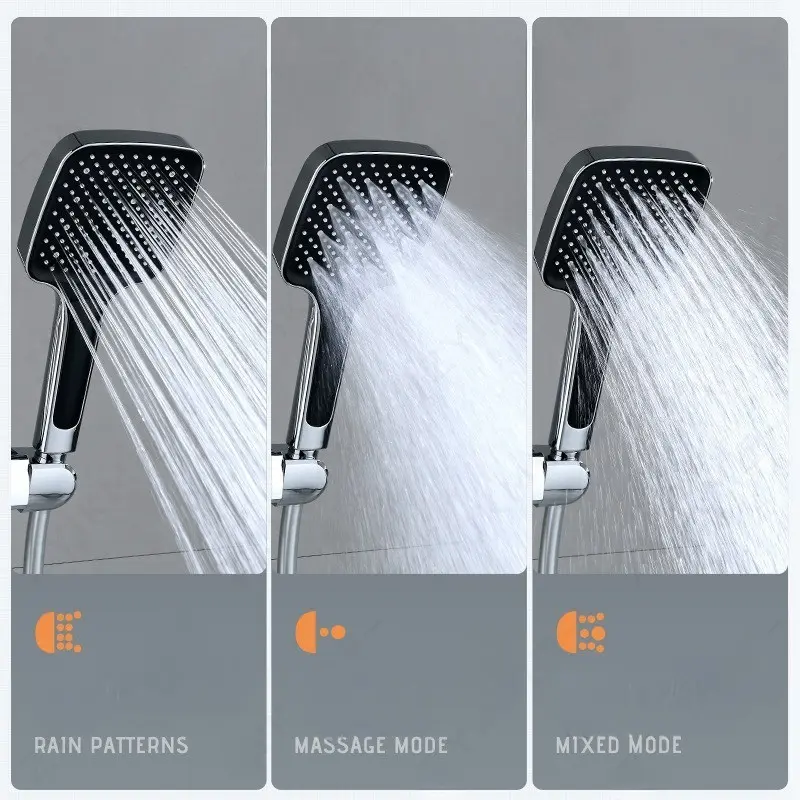
A multi-function head changes the outlet pattern. Depending on its design, a dial, lever or button moves an internal selector so water reaches different groups of nozzles. A rain setting may activate a broad outer area; a more focused setting may use a smaller central zone. Mixed mode may feed both. The important question is whether those settings are genuinely different when water is running, not whether the dial has several stops.
Do not confuse spray function with shower-system layout. A fixed wall head plus a handheld head is a two-outlet system, but either head may have one or several spray settings. Likewise, a “pause” position is a control state, not automatically another spray pattern. If the distinction is unclear on a listing, compare the visible nozzle zones and ask for a running demonstration of every setting.
This article compares function count within a shower head. If your decision is about the fixture itself, see our separate guide to handheld versus fixed shower heads. For a closer look at rain, pulse, jet and mixed patterns, use our spray-settings guide.
Inside the head: why the extra mode changes the engineering
Water enters a handheld shower through the hose connection, passes any screen and flow-control component, and reaches the distribution chamber behind the spray face. In a simple one-pattern design, the outlet path may feed one chamber directly. A multi-pattern head must send water to the correct chamber for the selected setting while keeping other zones closed. Our guide to how a shower head works maps these parts and the faults that can arise between them.
The selector is the central trade-off. It gives the user a choice, but it also creates positions that must align cleanly with ports and seals. If a selector stops between positions, two outlet zones may receive partial flow. The user can experience a weak, uneven pattern even though the supply pressure has not changed. If every mode is weak, the shared inlet, screen, hose or flow control is a more likely starting point than one individual spray zone.
Pressure is not a synonym for spray force. The plumbing supplies pressure; the shower head divides the available flow among its active nozzles. A concentrated setting can feel sharper because fewer streams cover a smaller area. That sensation does not prove the product increased upstream pressure or consumed more water. Compare the same head at the same valve position and measured inlet condition before calling one mode “more powerful.”
For a useful external benchmark, the U.S. EPA’s WaterSense showerhead guidance evaluates flow, spray force, spray coverage and pressure compensation, not the number of modes. Its Version 1.1 specification applies to handheld showerheads and sets a maximum rated flow of 2.0 gpm (7.6 L/min) for products that earn the label. These are program criteria, not a claim that any Huanyu model named here carries that label.
Single-function vs multi-function: the daily-use comparison
I would choose a single-function head when one comfortable spray covers the whole routine and nobody wants to operate a selector. I would pay for multiple functions when a second setting does a different job, such as focused rinsing after a broad daily spray. A dial with five stops is less useful than two clearly different patterns if three stops merely feel alike.
| Daily question | Single-function head | Multi-function head | What to check |
|---|---|---|---|
| Ordinary shower | One default spray with no switching step. | One preferred default mode, plus alternatives. | Is the normal setting good enough that you would use it every day? |
| Different users | Same pattern for everyone. | Can offer broad, focused or gentler patterns. | Do users actually need different spray jobs? |
| Rinsing speed | Depends on coverage, flow and nozzle design. | A focused setting may direct more of the available spray at one area. | Compare rinsing under the same supply condition. |
| Operation | Usually simpler because no mode selection is required. | Button or dial must be easy to find and complete each switch. | Try the control with wet hands, without looking at it. |
| Care | Clean one outlet pattern and its inlet path. | Clean each outlet zone; inspect the selector if only one mode misbehaves. | Can deposits be removed from every active zone? |
| Water use | Cannot be inferred from “one function.” | Cannot be inferred from mode count. | Check the exact model and setting at a stated test pressure. |
Notice the asymmetry: a multi-function head has more ways to match a situation, but only if a user can distinguish and reach those modes. A family member who never touches the selector gets no value from four additional settings. A person who alternates between a broad shower and a focused rinse may value just one extra setting more than an elaborate five-position dial.
It is also possible for a single-pattern head to feel better than the default setting on a multi-pattern head. Face size, nozzle direction, active outlet area and the upstream supply all affect the result. Never use “more functions” as a proxy for stronger spray. For the same reason, a multi-function head is not automatically harder to maintain: design quality and accessible nozzles matter more than a mode count alone.
Why we do not start a design review by counting spray settings
When I compare a single-function hand shower with a multi-function one, I do not start by counting modes. I start with the complaint a user is trying to solve.
Our published work on hotel-use hand showers describes three problems: guests wanted a spray that could rinse soap properly, cleaning staff dealt with blocked outlets, and property managers wanted fewer replacements. Adding another spray setting would not, by itself, solve any of those problems. The water path and the control had to be useful in daily operation.
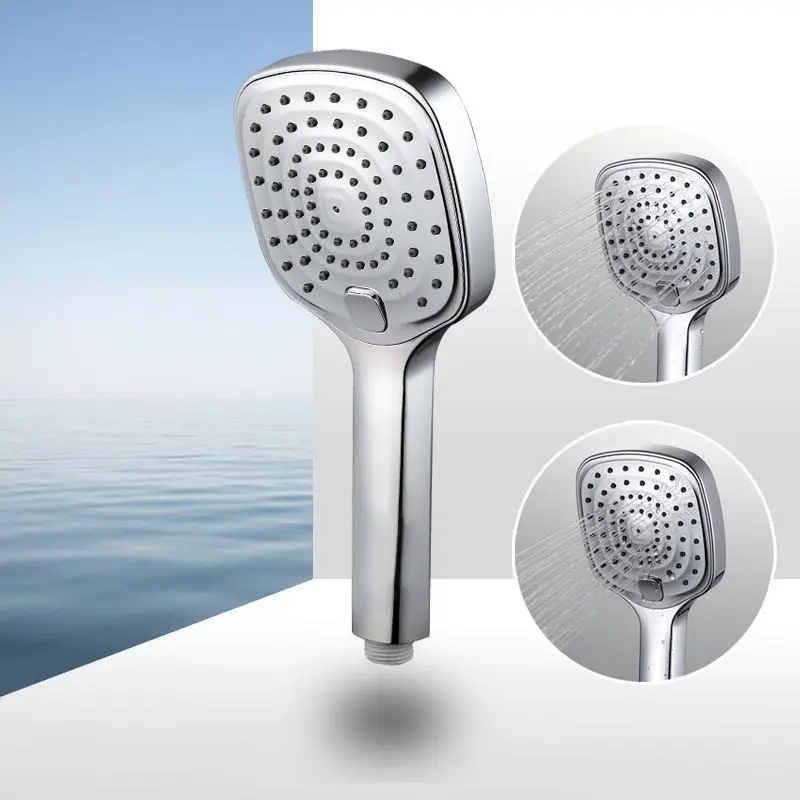
That thinking shaped our BHS11005 push-button hand shower. Its central outlets provide a more focused rinse, while the surrounding outlets provide wider coverage. The button lets a user change the active spray without turning a wet faceplate. The silicone outlets also give cleaning staff a more practical way to deal with deposits.
A single-function design can still be the better choice. If one spray gives reliable coverage and the user has no reason to change it, an extra selector adds another part to operate and maintain. For a multi-function design, I ask a harder question: does each setting do a noticeably different job? A focused rinse and a broad daily spray justify their place. Two settings that feel almost the same do not.
That is also how I would evaluate a model such as our LHS12005 three-spray hand shower. Its concentric outlet zones make the comparison tangible: look at which zone is active, how the spray covers the body, and whether switching gives the user a real benefit. For daily use, the best answer is not automatically “more functions.” It is the simplest water path that handles the tasks the user actually has.
Three Huanyu hand showers show three ways to build useful choice
Huanyu’s live catalogue gives concrete examples of multi-mode design. It also shows why a category label is not a substitute for an exact model specification. The Regular Hand Shower category contains products with different outlet layouts and spray functions. Do not assume every “regular” model is single-function; verify the function count on the selected product page or sample.
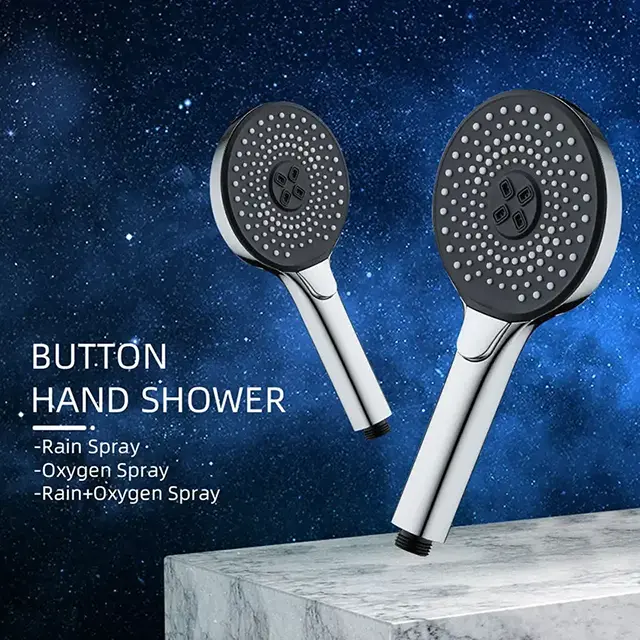
Broad versus focused
The live page lists a 120 mm ABS hand shower with a chrome surface, a push button, a central pulse zone and surrounding rain outlets. The useful comparison is the distinct job of each active zone, not the mere existence of a button.
See BHS11005 details
Concentric zones
The LHS12005 page identifies a 108 mm ABS hand shower with a chrome surface and stepped concentric outlets. Its central and outer zones provide a visible way to discuss targeted rinsing versus wider coverage.

More choice, same test
The prominent heading on the LHS12009 page identifies a five-function model with a 125 mm ABS body and chrome surface. Evaluate the actual spray options on the selected configuration rather than assuming five useful jobs.
These examples are not a controlled comparison of three products. They differ in face shape, outlet layout, controls and listed configuration. We do not assign a durability score or flow advantage without the same test conditions. A buyer planning a product range should compare samples at the intended hose, valve and supply pressure, then record which settings offer distinct benefits to the target user.
If you need a specific one-function SKU, request its exact model and sample from the Regular Hand Shower range. The range itself is not a promise that every listed model has only one setting. That distinction matters to both accurate product copy and a useful comparison.
The data case: flow rating tells you more than mode count
There is an easy way to see why “one mode saves water” and “more modes waste water” are both poor rules. The U.S. EPA states that a standard showerhead uses 2.5 gallons per minute, while a WaterSense-labeled showerhead must use no more than 2.0 gallons per minute. For a ten-minute shower at those stated rates, simple multiplication gives 25 gallons versus 20 gallons. That five-gallon difference comes from the flow rate in this example, not from the number of spray positions. The figures are an illustration based on EPA’s published values, not measured use of any model in this article.
Real-world use varies with the valve, supply pressure, hose, chosen setting and actual time spent showering. The calculation therefore cannot predict a household bill or a hotel’s annual consumption. It does tell us what to ask of a product listing: rated flow at a defined pressure, the market version of the exact SKU, and whether the rating applies across its modes. A flow number without a test condition is weak comparison material.
EPA’s WaterSense program also gives a more important performance lesson. Its showerhead specification covers handheld heads and assesses the combination of maximum flow, minimum flow at several pressures, spray force and coverage. The published specification uses 20, 45 and 80 psi test points. That does not mean every bathroom operates at those values; it means a meaningful test must describe the conditions rather than relying on the feeling of “high pressure.”
For your own installed head, a timed-container check can estimate delivered flow: collect water for a measured period, then divide volume by time. Keep the same valve opening and temperature mix when comparing modes. Our shower water-use guide explains the method and its limits. It is an at-home diagnostic, not a substitute for certification testing.
A practical selection test for daily use
You do not need a laboratory to make a better first decision. You do need to compare the same jobs under similar conditions. This sequence works for a household evaluating a sample and for a buyer building a hand-shower range. A commercial project should also document the exact market requirements and its own acceptance criteria before ordering.
- List the tasks before the models. Write down who uses the bathroom and what the head must do: normal body rinsing, washing long hair, bathing a child, rinsing a tub, washing a pet or serving guests who cannot be taught a complicated control. If there is only one recurring job, start by testing one excellent default pattern.
- Hold the supply conditions still. Compare heads with the same hose, valve position and water source where possible. A different valve opening can make one spray appear better for the wrong reason. Check that the inlet washer is seated correctly and the hose is not kinked before blaming the faceplate.
- Judge the default pattern without switching. Watch where the spray lands. A broad pattern can leave a weak centre; a tight pattern can demand constant hand movement. The best everyday setting should rinse comfortably without requiring a workaround.
- Make each extra mode prove its job. Switch to focused, rain or mixed modes and note which outlet zones activate. Does the next setting genuinely change coverage or rinse behavior? If two positions feel alike, count them as one useful choice for your decision, regardless of the marketing label.
- Operate the control as a user would. Try a button or dial with wet hands and without watching it. The selector should finish each movement clearly. It should not leave a weak in-between pattern or spray unexpectedly from an inactive zone. A setting that is inconvenient to reach is unlikely to be used regularly.
- Inspect upkeep before choosing. Check whether the outlet material can be wiped clean, whether dirt can be reached, and what the product instructions allow. Note whether a failed spray affects all modes or only one zone. For B2B selection, ask for the exact sample, technical drawing and function sequence, not merely a catalogue image.
For a family bathroom, multi-function can be worthwhile if two people genuinely prefer different water patterns. For a rental or guest bathroom, simple controls and a strong default setting may matter more than a long list of modes. For a retailer, the most useful assortment may include both: a straightforward everyday option and a visibly different multi-mode option. This is a merchandising judgment, not a claim that one design has a universally lower failure rate.
Maintenance: diagnose the water path before replacing the head
Function count changes the troubleshooting map. If every spray on a multi-function head becomes weak at the same time, suspect something shared by all modes: the upstream supply, hose, inlet screen or main flow path. If only one setting becomes weak or sprays sideways, focus on that setting’s nozzle group and selector route. A single-function head has no mode-to-mode comparison, so test hose-only flow and inspect its outlet face before concluding that the product itself is defective.
Mineral deposits can distort individual jets on either design. Flexible outlets may be cleared by rubbing them according to the manufacturer’s care instructions. Avoid pushing metal pins into tiny nozzles or opening sealed assemblies without instructions. A harsh cleaning method can create a new leak or damage a finish. Our guide to easy-clean silicone nozzles explains what the material does, while our button troubleshooting guide helps isolate a selector fault.
Leaks need the same location-first approach. Water escaping at the hose nut is not evidence that a multi-mode selector failed. A drip from an inactive outlet zone while another mode runs points closer to the internal path. A few drops after shutoff may simply be water draining from the face and hose. If you cannot tell which is happening, first observe whether the leak appears at a joint, body seam or nozzle outlet; do not open a sealed head merely because water is visible.
The maintenance decision is therefore not “simple always lasts” or “more functions always break.” It is whether the chosen design lets you recognise, clean and resolve the faults likely in that bathroom. Buyers should inspect how the model is assembled and what evidence accompanies its testing. Huanyu’s service page describes assembly checks for leakage and function, pre-shipment inspection records and a process for handling quality complaints. Those are concrete questions to take into a sample review.
FAQ: the questions that matter after the comparison
Is a single-function shower head stronger than a multi-function one?
Not necessarily. A single pattern can feel focused, while a multi-function head can offer a focused setting of its own. Spray sensation depends on the active nozzles, flow and supply condition. Compare actual models under the same conditions rather than inferring strength from function count.
Do multi-function shower heads use more water?
Not by definition. Water use depends on the exact model, setting, rated flow and shower duration. A head with more settings may still have a lower rated flow than a one-setting head. Ask for the model-specific flow information and its test pressure.
Which is easier to clean?
The easiest model is the one whose active outlets and inlet screen you can maintain as instructed. A single-function head has one spray pattern to inspect; a multi-function head has several outlet zones and a selector. Outlet material and access often matter more than the number printed on the package.
Are five spray settings better than three?
Only if the extra settings provide useful differences. Compare which nozzles run, the coverage and the control movement. A clear broad spray and a clear focused rinse can be more useful than several nearly identical stops.
Can I call every Huanyu Regular Hand Shower single-function?
No. Huanyu’s Regular Hand Shower category includes models with multiple spray settings. Check the exact product page or sample before describing a SKU as one-function, three-function or five-function.
Still deciding between fixed and handheld hardware rather than spray modes? Start with the handheld-versus-fixed comparison. It answers a different question and can prevent choosing the right spray settings on the wrong fixture type.
Choose from a real sample, not a function count
Huanyu Sanitary Ware publishes its production and testing equipment, sample-to-shipment service process and individual hand-shower specifications. For this comparison, the useful evidence is an exact model, its active spray zones, flow information for the intended market and a sample you can test on your own fixture.
Our published customer case concerns market positioning and a mid-range showerhead programme; it is not a single-versus-multi-function performance trial. We do not use it as proof that either design wins this comparison. A buyer should ask for the product drawing, sample and test records relevant to the exact model under consideration, rather than borrow a result from another programme.
Discuss a hand-shower configuration
Send the desired spray jobs, target market, hose connection, finish and the model or reference you want to compare. Ask our team to identify a regular, button-control or other suitable option, then verify the proposed sample against your requirements.
Contact Huanyu
Email: info@nbhuanyu.com
Phone: +86-13857806071